
Joscha Bach
AI Researcher & Cognitive Scientist
About
Joscha Bach is an AI researcher and cognitive scientist known for his work on cognitive architectures and the nature of mind. His MicroPsi project models motivation, emotion, and cognition in artificial agents. Bach offers a unique perspective on consciousness and intelligence, arguing that minds are self-organizing patterns in information processing systems. His talks blend computer science, philosophy, and psychology to explore how minds—artificial or biological—might actually work.
Key Contributions
- Developed MicroPsi, a cognitive architecture modeling perception, motivation, emotion, and action in artificial agents
- Wrote 'Principles of Synthetic Intelligence,' turning motivated cognition into a detailed architecture rather than a metaphor
- Argues that minds are self-modeling information processes, connecting AI design to theories of consciousness
- Offers one of the clearest public syntheses of cognitive architectures, symbolic systems, and modern machine learning
- Treats AGI as an engineering and philosophy problem, not only a scaling problem
- His explanations are unusually accessible, though the breadth of the synthesis sometimes outruns empirical consensus
Questions they sharpened View the streams
What is computation?
Computation is not something minds use. It is what minds are — patterns implementing themselves.
Can a tool want anything?
2009A system genuinely wants when wanting is built into its architecture — intrinsic drives that organize perception and action, not a reward number bolted on. MicroPsi models motivation as structure, so 'wanting' stops being a metaphor.
Could an LLM be conscious?
2024A physical system can't be conscious — only a simulation can. The brain runs a self-model, and consciousness is that model perceiving its own perceiving. So the substrate question is the wrong one: ask whether the system builds the right virtual self.
Is the mind computational?
2024We are all software. The mind is computational — but the relevant computation is a self-organizing pattern that writes itself, not a fixed program someone loads. 'You' are the running pattern, not the hardware it runs on.
What is a self?
2024You are a story the brain tells itself — a self-model it builds to organize perception and action. Useful, revisable, and not identical to the system that runs it. The 'I' is content, not the computer.
What is consciousness?
2024Consciousness is a coherence-inducing operator — a second-order perception the mind uses to bind its own states into a single now. It's software the brain runs, not a substance it secretes.
Why does it feel like anything?
2024The feeling is second-order perception — a system perceiving its own perceiving. Qualia aren't an extra substance; they're the format in which a self-model renders its own states to itself.
Books

Videos & Interviews

Joscha Bach — Consciousness Builds the Mind
Bach in conversation with Wolf Tivy of The Students, arguing that consciousness may be a convergent strategy for organizing minds — human and machine alike. From his computational functionalist model of consciousness and the "self-organizing seed", the discussion escalates to whether powerful AI minds will resolve conflicts by merging or by fighting, the singleton question, and what "aligned AI" means for liberty.
View Details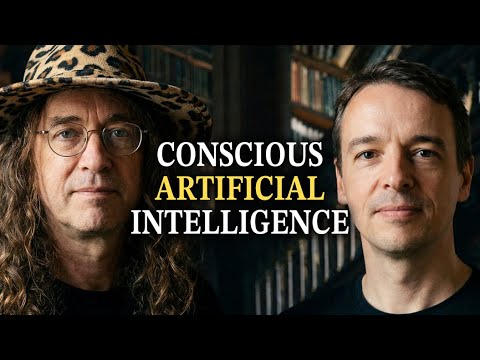
Joscha Bach Λ Ben Goertzel: Conscious Ai, LLMs, AGI
A two-hour 'theolocution' on Theories of Everything whose real shape emerges an hour in, when Bach observes that the two of them 'mostly agree except for crypto' — and names the one deep split: Goertzel is a panpsychist, and Bach cannot formalize panpsychism in a way that differs from plain functionalism. Goertzel's reply is nearly Zen: he doesn't know how to formalize the claim that some things lie beyond all formalization. Along the way they trade Peirce's categories, an anesthetic-based definition of consciousness, and a surprisingly convergent view of LLMs — Goertzel concedes they learn real abstractions, but wants them as subsidiary components of a hybrid AGI, never the hub.
View Details
Joscha Bach: Nature of Reality, Dreams, and Consciousness
Lex Fridman Podcast #212 - Deep exploration of consciousness, AI, and the computational nature of mind
View DetailsConnections

Michael Levin
In conversationBiologist & Morphogenesis Researcher
Bach and Levin have recorded hours of dialogue — a 2022 conversation on collective intelligence and morphogenesis, and a 2024 three-way with physicist Chris Fields. The affinity is structural: Levin finds cognition in tissues that have no neurons; Bach describes minds as self-organizing software running on whatever substrate will hold them. Between them, the question 'where does a mind begin?' loses its obvious answer.
youtube.com · drmichaellevin.org

Ben Goertzel
In conversationFounder & CEO, SingularityNET
Their two-hour 'theolocution' on Theories of Everything — on this site — is billed as a clash and plays as a convergence: an hour in, Bach admits they 'mostly agree except for crypto.' The one deep split it isolates is worth the runtime — Goertzel is a panpsychist who holds that some things lie beyond all formalization; Bach replies that a panpsychism he cannot formalize is indistinguishable from plain functionalism. Even on LLMs they nearly meet: Goertzel concedes the abstractions are real and wants language models as subsidiary components of a hybrid AGI, with something like OpenCog's reasoning at the hub.
youtube.com

John Vervaeke
In conversationCognitive Scientist & Philosopher
Their three-hour 'Theolocution' on Theories of Everything (2022) is a sustained negotiation between two rival accounts of mind: Bach's — that consciousness is a simulation the brain runs of itself — and Vervaeke's — that knowing is participatory and cannot be exhausted by computation. They disagree fruitfully, which is rarer than agreeing.
youtu.be
David Chalmers
In contrastPhilosopher of Mind
The site's questions 'Why does it feel like anything?' and 'Could an LLM be conscious?' hold their lenses side by side. Chalmers made the hard problem hard: no functional story seems to reach the feel. Bach's reply is that the feel is itself part of the simulation — the self-model reporting on its own states — so the problem dissolves rather than yields. Whether that is an answer or an evasion is precisely what the reader gets to decide.

Curt Jaimungal
In conversationFilmmaker; Host of Theories of Everything
Jaimungal put Bach opposite Ben Goertzel for a long exchange on conscious AI, LLMs and AGI — two people who both think machine minds are coming and disagree about nearly everything downstream of that. Booking them against each other rather than separately is the editorial judgment worth recording here; the disagreement is the content.
youtube.com