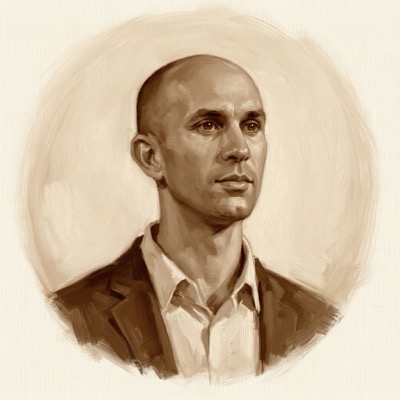
Anil Seth
Professor of Cognitive & Computational Neuroscience, University of Sussex
About
Anil Seth (born 1972) is a neuroscientist who studies the biological basis of consciousness. He took a PhD in computer science and AI at Sussex before turning to the brain, and has co-directed the Sussex Centre for Consciousness Science since 2010. His central claim is that perception is a controlled hallucination: the brain is a prediction machine making its best guess at the causes of its sensory signals, and experience is that guess rather than a readout of the world — "when we agree about our hallucinations, we call that reality." In Being You (2021) he extends the account to selfhood, arguing that the sense of being someone is itself a prediction anchored in the body's need to stay alive, which makes consciousness a property of living systems rather than of clever ones. That distinction drives his scepticism about machine consciousness: intelligence is about doing, consciousness is about feeling and being, and the assumption that the two must travel together is, he argues, a fact about human psychology rather than about reality. His essay The Mythology of Conscious AI won the 2025 Berggruen Prize Essay Competition.
Key Contributions
- Developed the 'controlled hallucination' account of perception — the brain as a prediction engine whose best guess, corrected by error, is what we experience as the world
- Wrote Being You: A New Science of Consciousness (2021), extending predictive processing from perception to selfhood via the 'beast machine' argument that conscious selves are grounded in staying alive
- Co-directs the Sussex Centre for Consciousness Science and edits the journal Neuroscience of Consciousness, helping make consciousness a tractable empirical science
- Argues that consciousness and intelligence are separable — that scaling capability does not produce sentience, and that seeing minds in language models is closer to seeing faces in clouds
- Won the 2025 Berggruen Prize Essay Competition for 'The Mythology of Conscious AI', which targets the assumption that the brain is a computer that happens to be made of meat
Videos & Interviews
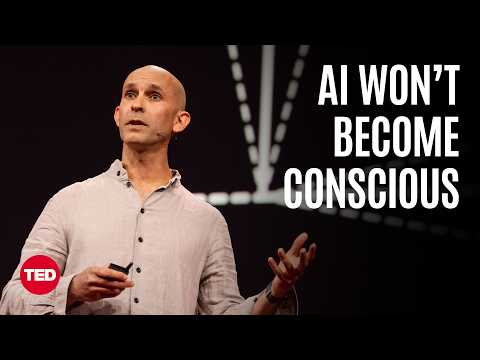
Why AI Isn't Going to Become Conscious
Seth's argument turns on a distinction the field keeps collapsing: "Intelligence is all about doing... Consciousness, on the other hand, it's all about feeling and being." They arrive together in humans, so we assume they travel together in general — but that assumption, he says, "is a reflection of our own psychology, not an insight into the nature of reality."
View Details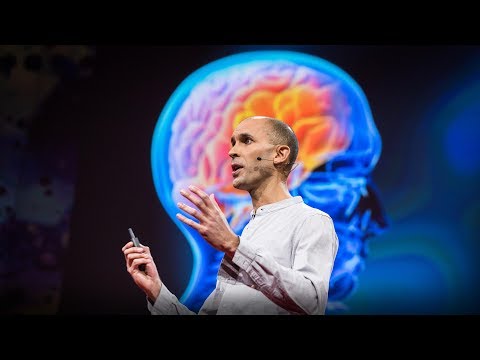
Your Brain Hallucinates Your Conscious Reality
Seth opens by describing the third time in his life he ceased to exist — going under anaesthetic, which he calls "a modern kind of magic. It turns people into objects, and then, we hope, back again into people." From there he builds the argument that made his name: perception is not a window onto the world but a controlled hallucination. The brain is a prediction engine making its best guess at the causes of its sensory signals, and what we experience is that guess, corrected by error rather than assembled from data. "When we agree about our hallucinations, we call that reality."
View DetailsPapers & Publications

Being You: A New Science of Consciousness
2021His account of consciousness as controlled hallucination, extended from perception to the experience of being a self — and to why that self is the kind of thing a living body has
View BookThe Mythology of Conscious AI
2025The Berggruen Prize-winning essay against the assumption that consciousness is a computation the brain happens to run in meat
Read PaperConnections
Evan Thompson
DebatedPhilosopher of Mind & Cognitive Science
In 'Reality is not a controlled hallucination' (March 2026) Thompson names Seth as the popularizer of a thesis he considers "bad philosophy" wearing the clothes of new science — one that "traces back to Hermann von Helmholtz" and remains "debatable philosophy from the nineteenth century." His central charge is a category error: perception belongs to the whole animal engaging its world, not to the organ doing the modelling. "Thinking that perception happens inside the brain is like thinking that flying happens inside the bird's wings." Seth has not published a reply. The disagreement is sharper for how much they share. Both tie mind to being a living body; both reject the brain-as-computer picture. They split on where experience happens — in the model the brain builds, or in the traffic between a creature and its surroundings — and that is exactly the question you must answer before you can say what, if anything, is missing in a system with no surroundings to engage.
iai.tv
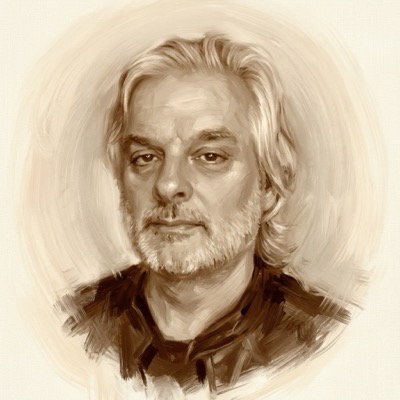
David Chalmers
In contrastPhilosopher of Mind
Chalmers named the hard problem: why physical processing is accompanied by experience at all. Seth's counter-move is not to solve it but to decline it — he proposes the "real problem," which asks science to explain, predict and control the properties of experience rather than to explain its existence, on the wager that the mystery will dissolve the way élan vital did once biology could account for what living things actually do. Whether that is progress or evasion is one of the live disagreements in consciousness studies, and it decides what would even count as evidence about a machine.
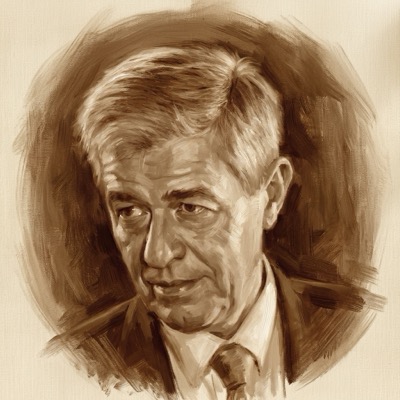
Karl Friston
CollaboratedNeuroscientist & Theoretical Biologist
Seth and Friston co-authored 'Active interoceptive inference and the emotional brain' (Philosophical Transactions of the Royal Society B, 2016), which turns the free energy principle inward: the brain does not only predict the world outside, it predicts the state of the body it is keeping alive. That move is the hinge of Seth's later work — if selfhood is the brain's best guess about its own viscera, then being someone is tied to being a living thing, and a system with no body to regulate has nothing for the guess to be about.
ncbi.nlm.nih.gov · Active interoceptive inference and the emotional brain, Phil. Trans. R. Soc. B 371(1708), 2016
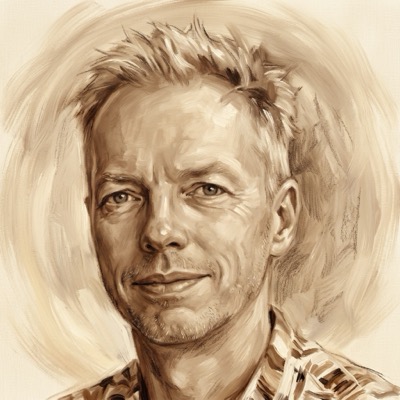
Andy Clark
KindredPhilosopher & Cognitive Scientist
Two readings of the same idea, pursued from different chairs. Clark made predictive processing philosophically respectable — the mind as a prediction engine, the boundary between brain, body and world negotiable rather than given. Seth took the same machinery into the laboratory and pointed it at consciousness and the body, arriving at a claim Clark's framework permits but does not require: that experience is not merely predicted but predicted from the inside out, by something with a stake in staying alive.