
About
Michael Tomasello (born 1950) is an American developmental and comparative psychologist. He took his doctorate at the University of Georgia in 1980, taught at Emory University through the 1980s and 1990s, and from 1998 to 2018 co-directed the Max Planck Institute for Evolutionary Anthropology in Leipzig, where he compared young children with great apes at the Wolfgang Köhler Primate Research Center. Since 2016 he has been a professor of psychology and neuroscience at Duke University. His account of language starts before words: infants learn to share attention with another person, and a word is a convention two people use to direct each other's attention to something, under one description rather than another. He rejects Chomsky's innate universal grammar in favour of a usage-based theory in which children build a language from intention-reading and pattern-finding, and he calls the way each generation inherits and improves the tools of the last 'the ratchet effect.' Primatologists including Frans de Waal and Christophe Boesch have argued that his laboratory comparisons overstate the gap between humans and other apes. His work asks a pointed question of a language model: it has learned the conventions, without ever having shared attention with anyone.
Key Contributions
- Showed that joint attention, a child and an adult attending to the same thing and knowing it, comes before language and makes it possible
- Proposed the usage-based theory of language acquisition: children build grammar from intention-reading and pattern-finding, not from an innate universal grammar
- Named the 'ratchet effect', by which human culture accumulates because each generation inherits and modifies what the last one made
- Argued in The Cultural Origins of Human Cognition (1999) and Origins of Human Communication (2008) that pointing and shared intentionality are the ground language grew from
- Co-directed the Max Planck Institute for Evolutionary Anthropology (1998–2018), comparing the social cognition of children and great apes
Connections
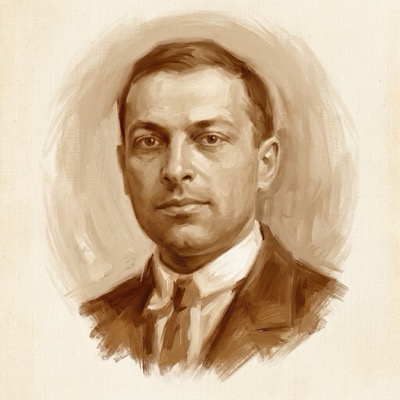
Lev Vygotsky
Influenced byPsychologist of Language & Development
Tomasello presents his account of how a child becomes human as a neo-Vygotskian one: Becoming Human (2019) builds on Vygotsky's idea that a mind is formed through the culture around it. He keeps the insight and moves its weight, from what culture hands down to what lets it exist at all: the capacity of two people to attend to one thing, together, and know that they do.
evolutionaryanthropology.duke.edu · Michael Tomasello, Becoming Human: A Theory of Ontogeny (Harvard University Press, 2019)
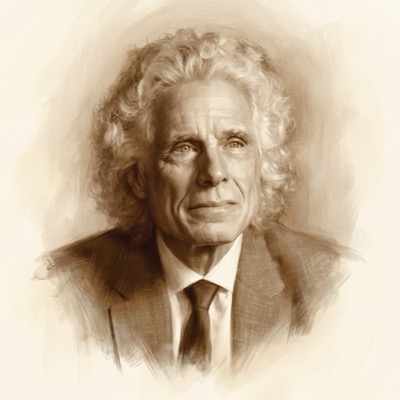
Steven Pinker
DebatedCognitive Psychologist & Linguist
A year after Pinker's The Language Instinct, Tomasello answered with a long review whose title is the whole objection: 'Language Is Not an Instinct' (1995). Where Pinker describes an inborn faculty for grammar, Tomasello describes children working out what adults mean and building grammar from use. The question between them is still open: is language something we have, or something we do together?
Michael Tomasello, "Language Is Not an Instinct", Cognitive Development 10(1), 131–156 (1995), doi:10.1016/0885-2014(95)90021-7 · cognitionandculture.net
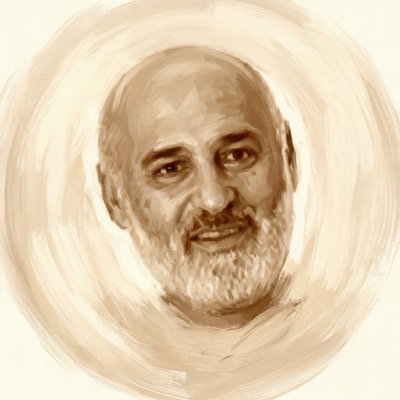
Daniel Dor
KindredLinguist & Media Researcher, Tel Aviv University
An interpretive pairing: both treat language as something that happens between people before it is anything inside one head. Read together, they divide the ground. Tomasello explains how we come to share a scene, by pointing within it; Dor asks what had to be invented to speak of what no one present can see, and answers: instructions for imagining.

Ludwig Wittgenstein
Influenced byPhilosopher of Language & Logic
Wittgenstein noticed that a pointing finger says almost nothing by itself: the paper, its shape, its colour, its number? Tomasello cites him for exactly this and turns the remark into experiments, showing that an infant's point is understood only against attention the two people already share. What Wittgenstein called a form of life, Tomasello studies as common ground.
eva.mpg.de · Tomasello, Carpenter & Liszkowski, "A New Look at Infant Pointing", Child Development 78(3), 2007