About
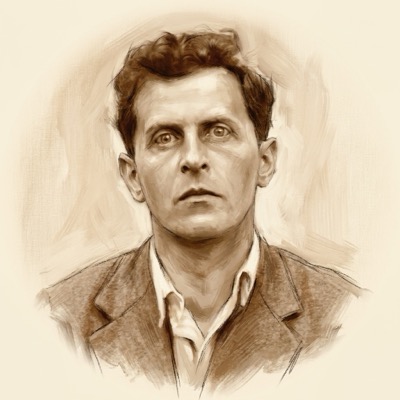
Ludwig Wittgenstein (1889–1951) was born in Vienna into one of Europe's richest families and arrived unannounced at Bertrand Russell's rooms in Cambridge in 1911 to study logic. He drafted the Tractatus Logico-Philosophicus (1921) while serving in the Austro-Hungarian army in the First World War — carrying Tolstoy's The Gospel in Brief so constantly that soldiers called him 'the man with the gospels' — and, believing he had solved philosophy's problems, spent much of the 1920s as a schoolteacher in rural Austrian villages. The Tractatus inspired the Vienna Circle, but after returning to Cambridge in 1929, where he taught until 1947 and succeeded G. E. Moore in the chair of philosophy in 1939, he dismantled much of it himself. The posthumous Philosophical Investigations (1953) replaced the picture of language as a logical mirror of the world with language games, family resemblance, the private language argument, and the claim that for a large class of cases 'the meaning of a word is its use in the language.' That later claim reads now like a question addressed directly to systems that learn words from nothing but their use.
Key Contributions
- Wrote the Tractatus Logico-Philosophicus (1921), a theory of how propositions picture the world that inspired the Vienna Circle
- Argued in the Philosophical Investigations (1953) that the meaning of a word is, in a large class of cases, its use in the language
- Introduced language games and family resemblance as alternatives to defining words by fixed essences
- Formulated the private language argument and the rule-following problems later sharpened by Saul Kripke
- Lectured on the foundations of mathematics at Cambridge in 1939, arguing the point with a young Alan Turing in the room
Connections
Alan Turing
DebatedMathematician & Computer Science Pioneer
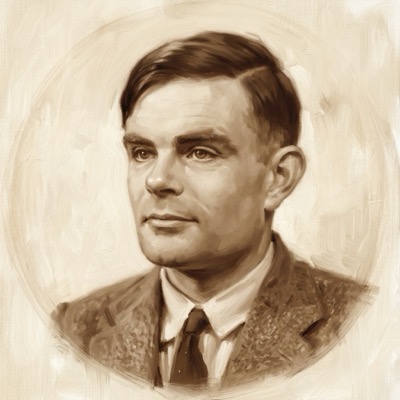
In 1939 Turing sat in Wittgenstein's Cambridge lectures on the foundations of mathematics, and the notes students kept record the two of them arguing: Turing defending formalism, Wittgenstein insisting that mathematics does not discover truths but invents them. One man had just defined what it is for a machine to follow a rule; the other was asking what following a rule could even consist in. Every argument about whether a model that follows rules understands them reopens that room.
en.wikipedia.org · en.wikipedia.org · Wittgenstein's Lectures on the Foundations of Mathematics, Cambridge 1939, ed. Cora Diamond (1976)
Leo Tolstoy
Influenced byNovelist & Moral Philosopher
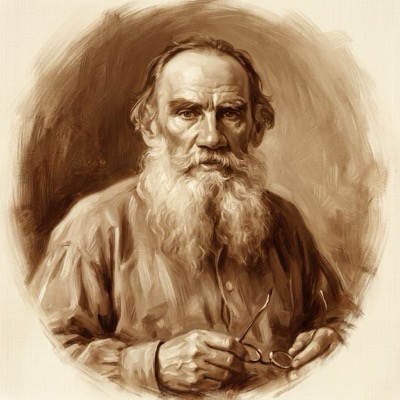
As a soldier in the First World War, Wittgenstein found Tolstoy's The Gospel in Brief in a bookshop in Tarnów and carried it everywhere, pressing it on anyone in distress until his fellow soldiers called him 'the man with the gospels.' The Tractatus, drafted in those same years, numbers its sentences in the book's peculiar way. The most austere work of logic of the century was written beside a novelist's account of what a life is for — and ends by pointing at what logic cannot say.
en.wikipedia.org
Rudolf Carnap
InfluencedPhilosopher & Logician
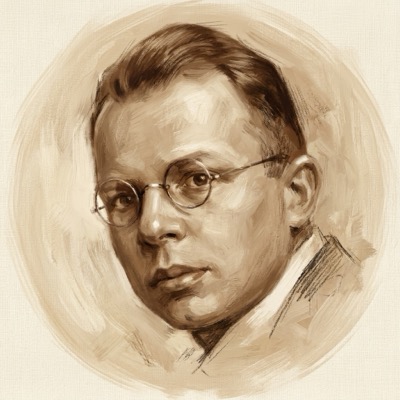
Carnap joined Schlick's circle just as it began another careful reading of the Tractatus, and took from it the idea that logical truths are tautologies, empty of empirical content — the piece logical empiricism needed to fit mathematics into an empiricist world. From 1927 to 1928 he sat in on the small meetings Wittgenstein allowed, and his autobiography calls Wittgenstein the thinker who most inspired him, while recording the gulf between them: Carnap approached problems as a scientist, Wittgenstein 'like a creative artist,' almost a seer. The most influential program to make philosophy a science grew from a book whose author never wanted it to be one.
en.wikipedia.org · plato.stanford.edu
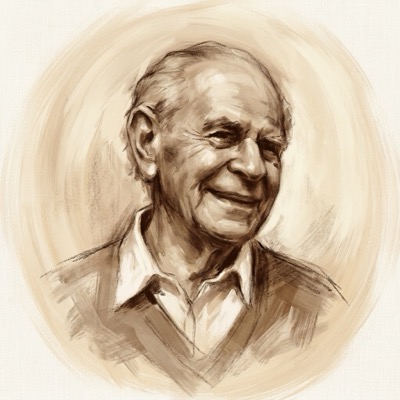
Karl Popper
DebatedPhilosopher of Science
On 25 October 1946, at the Moral Sciences Club in Cambridge, Popper read a paper arguing that philosophical problems are real, not linguistic puzzles to be dissolved — a direct challenge to Wittgenstein, who was in the room with Russell. Accounts disagree about the poker Wittgenstein waved and when he left, but the minutes record a meeting 'charged to an unusual degree with a spirit of controversy.' The question they fought over returns whenever someone says a debate about machine minds is only a confusion about words.
en.wikipedia.org

