About
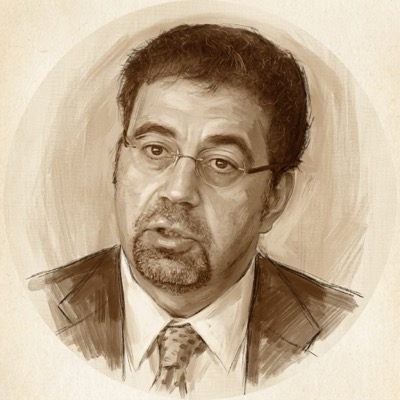
Daron Acemoglu (b. 1967) is an Institute Professor at MIT and, with Simon Johnson and James Robinson, a 2024 Nobel laureate in economics for work on how institutions shape prosperity. Turkish-American, educated at York and the LSE, he won the John Bates Clark Medal in 2005. His argument about technology is that its benefits are not automatic: whether a machine augments workers or merely replaces them is a choice made by the people directing it, and history is full of stretches where the gains went to a narrow few. He is also the most cited sceptic of large near-term AI productivity gains, estimating in 2024 that total factor productivity would rise by under 1% over a decade — a figure far below what the industry assumes, and one he arrived at by counting which tasks AI can actually do rather than by extrapolating from capability.
Key Contributions
- Shared the 2024 Nobel Memorial Prize in Economic Sciences for comparative studies of how institutions form and affect prosperity
- Co-wrote Power and Progress (2023) with Simon Johnson, arguing that who captures the gains from technology is a political choice rather than a technical inevitability
- Co-wrote Why Nations Fail (2012) and The Narrow Corridor (2019) with James Robinson, on institutions, liberty and the balance between state and society
- Published The Simple Macroeconomics of AI (2024), estimating AI's ten-year total factor productivity gain at under 1% by counting exposed tasks rather than extrapolating capability
- Won the John Bates Clark Medal in 2005 for contributions to labour economics, political economy and the economics of technology
Videos & Interviews
AI Is Not Improving Productivity: Nobel Laureate Daron Acemoglu
The economist who put a number on AI's productivity gain explains how he got it, and why it is so much smaller than the industry's. His method is to count which tasks the technology can actually take over and what each saves, rather than reasoning down from how capable the models look.
View Details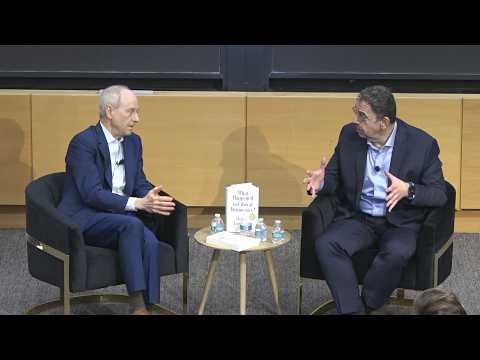
Daron Acemoglu and Michael Sandel: What Happened to Liberal Democracy?
At MIT's Stone Center, Michael Sandel questions Daron Acemoglu about his book What Happened to Liberal Democracy?: how center-left parties lost the working class, why redistribution cannot replace "the need to be needed" that Sandel calls contributive justice, why pro-worker AI should enhance work rather than replace it, and why a technology said to transform every part of life cannot be left to "a few frontier labs."
View DetailsConnections
Simon Johnson
CollaboratedProfessor of Entrepreneurship, MIT Sloan
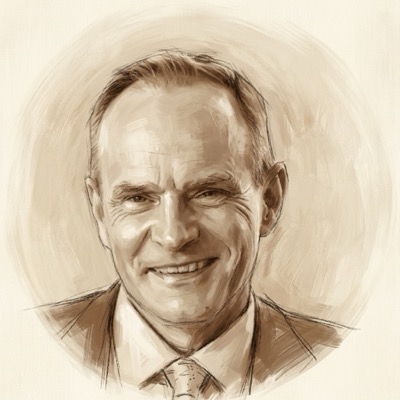
Co-authors of Power and Progress (2023) and co-laureates of the 2024 Nobel, with James Robinson, for work on how institutions make or destroy prosperity. The book is a thousand-year argument against the idea that technology carries its own direction: the gains from a new machine go where institutions send them, and for long stretches of history they went almost nowhere near the people operating it. Acemoglu brings the task-level economics, counting what a technology actually displaces; Johnson brings the institutional and financial history. What makes the pair matter here is that they draw the same conclusion about AI from opposite ends of the evidence, and that conclusion is a choice rather than a forecast.
Power and Progress: Our Thousand-Year Struggle Over Technology and Prosperity (PublicAffairs, 2023) · nobelprize.org · shapingwork.mit.edu
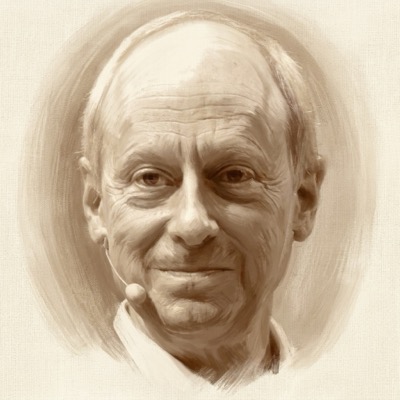
Michael Sandel
Influenced byPolitical Philosopher, Harvard University
In their MIT conversation Acemoglu names three debts to Sandel: the role of community, from his earlier work; the way a meritocratic reading of success and failure humiliates those not doing as well; and contributive justice, the idea that people need not only consumption but the sense of contributing. All three run through Acemoglu's working-class liberalism, which holds that redistribution cannot stand in for wage growth and the dignity of work.
youtube.com · Daron Acemoglu, What Happened to Liberal Democracy? Remaking a Politics of Shared Prosperity (2026)

Daniel Susskind
In conversationEconomist, King's College London & Oxford
In May 2024 Oxford's Institute for Ethics in AI and the Oxford Martin School invited Acemoglu to argue that AI's current path is inimical to human flourishing, then had Susskind respond from the panel. The two share the premise that the gains from automation are not automatically shared; where they part is on whether steering the technology is enough, or whether a world with less work needs new ways to distribute income and meaning altogether.
oxfordmartin.ox.ac.uk
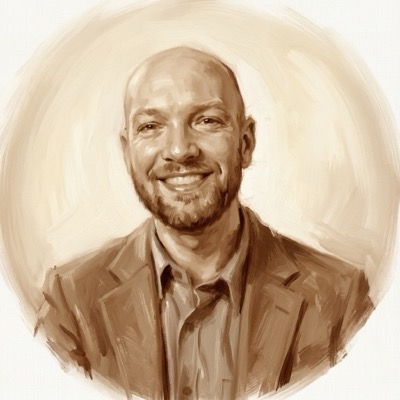
Peter McCrory
KindredChief Economist, Anthropic
Describing what he wants his team to do inside Anthropic, McCrory put it 'in the language of the economics literature': can the lab 'operationalize directed technical change,' steering its models toward augmenting labor rather than displacing it? Acemoglu formalized directed technical change in 2002 and has since argued, most fully in Power and Progress, that which way a technology cuts is a choice, not a law. McCrory carries that question inside the company that builds the technology, and admits he does not yet know whether it can be answered there.
youtube.com · Acemoglu, "Directed Technical Change," Review of Economic Studies 69(4), 2002

