
Simon Johnson
Professor of Entrepreneurship, MIT Sloan
About
Simon Johnson is the Ronald A. Kurtz Professor of Entrepreneurship at the MIT Sloan School of Management, where he heads the Global Economics and Management group and co-directs the Shaping the Future of Work Initiative. He served as Chief Economist of the International Monetary Fund from 2007 to 2008. In 2024, he was awarded the Nobel Memorial Prize in Economic Sciences alongside Daron Acemoglu and James A. Robinson for their studies of how institutions are formed and affect prosperity. He co-authored Power and Progress: Our 1,000-Year Struggle Over Technology and Prosperity, which argues that technological progress does not automatically benefit society broadly.
Key Contributions
- Shared the 2024 Nobel Memorial Prize for work showing how institutions shape long-run prosperity
- Co-authored 'Power and Progress,' arguing that technology only broadly helps workers when institutions force shared gains
- Applies economic history to AI, warning that automation can concentrate power unless labor and policy actively redirect it
- Served as IMF Chief Economist during the financial-crisis era, bringing institutional-risk analysis into public debate
- Co-authored '13 Bankers,' helping popularize the argument that concentrated financial power can distort democracy and crisis response
- His AI argument usefully counters techno-optimism, though critics see it as underweighting productivity upside and entrepreneurial adaptation
Videos & Interviews

AI vs. Human Jobs Ft. Andrew Yang, Chris Hughes, Simon Johnson and Rumman Chowdhury
Panel discussion on AI's impact on employment and economic inequality
View Details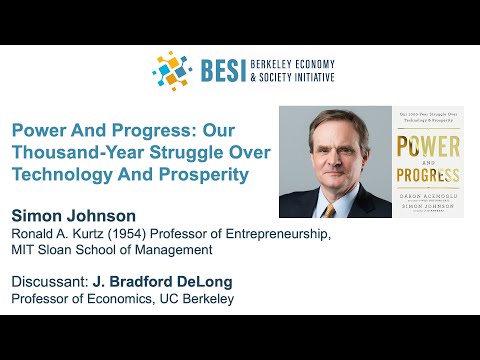
Power and Progress: Our Thousand-Year Struggle Over Technology and Prosperity
Berkeley BESI talk with Brad DeLong on a thousand years of technology shaping prosperity
View Details
Technology and Inequality in the Age of AI
San Francisco Fed talk on how AI may deepen inequality without deliberate institutional choices
View DetailsConnections

Daron Acemoglu
CollaboratedInstitute Professor of Economics, MIT
Co-authors of Power and Progress (2023) and co-laureates of the 2024 Nobel, with James Robinson, for work on how institutions make or destroy prosperity. The book is a thousand-year argument against the idea that technology carries its own direction: the gains from a new machine go where institutions send them, and for long stretches of history they went almost nowhere near the people operating it. Acemoglu brings the task-level economics, counting what a technology actually displaces; Johnson brings the institutional and financial history. What makes the pair matter here is that they draw the same conclusion about AI from opposite ends of the evidence, and that conclusion is a choice rather than a forecast.
Power and Progress: Our Thousand-Year Struggle Over Technology and Prosperity (PublicAffairs, 2023) · nobelprize.org · shapingwork.mit.edu

Daniel Mügge
KindredProfessor of Political Arithmetic, University of Amsterdam
An alignment of argument rather than a documented exchange: two political economists who refuse the premise that technology has a direction of its own. Johnson reads a thousand years of machinery in Power and Progress and finds that new tools spread their gains only when institutions force them to, and otherwise concentrate them. Mügge arrives at the same place from the regulatory end, sorting innovation into the good, the useless and the harmful and asking what a society would have to do to get more of the first — a question that only makes sense if the mix is something chosen. For both, 'will it be adopted' is the wrong question and 'on whose terms' is the right one.