
About
Dan Shipper is the CEO and co-founder of Every, a media company publishing a daily newsletter on business, AI, and personal development read by nearly 75,000 founders, operators, and investors. He writes the column Chain of Thought, exploring the frontiers of AI in work and life. Before Every, he co-founded Firefly (acquired by Pega in 2014) and worked as a Partner at First Round Capital.
Key Contributions
- Founded Every, turning an independent media company into a laboratory for AI-native writing, products, and consulting
- Writes Chain of Thought, documenting how language models change work, creativity, management, and software practice
- Popularizes concrete AI workflows rather than abstract futurism, often showing the messy details of using tools in real organizations
- Argues for AI-native company design, including small teams and heavy use of agents and automation
- His enthusiasm is useful because it is hands-on, though the model may generalize less cleanly to organizations with regulation, legacy systems, or lower trust
Videos & Interviews

Connections
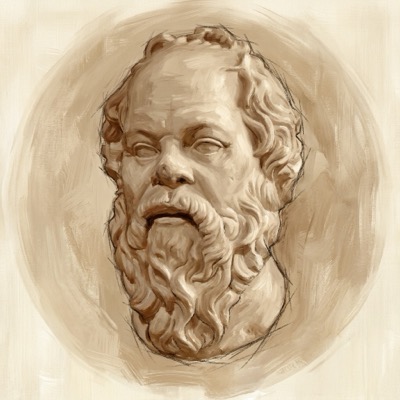
Socrates
In contrastAthenian Philosopher & Questioner
Shipper builds his account of AI on a scene from Plato's Protagoras: Socrates refuses the old teacher's myths and demands a definition of excellence, on the grounds that what you cannot define you do not know. Shipper calls Socrates the father of rationalism and traces the demand through Galileo and Newton; neural networks, which learn without definitions, quietly vindicate Protagoras. The opposition lays the question bare: whether knowing has to be something you can state, or whether practice can carry it.
youtube.com · every.to
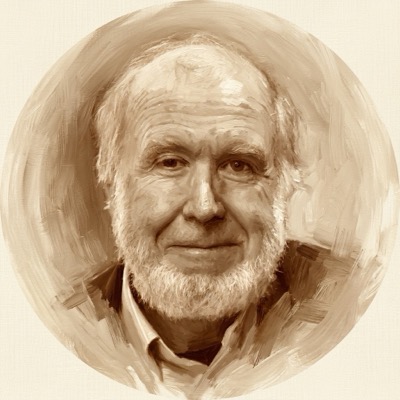
Kevin Kelly
In conversationFounding Executive Editor, Wired
In April 2025 Shipper welcomed Kelly to AI & I as 'a personal hero of mine' and asked how to predict the future. Kelly suggested that intelligence is not an element but a compound of different cognitive parts, so we will make 'hundreds of various other kinds' of minds rather than climbing one ladder toward a single superintelligence. Shipper said hearing Kelly on this over the years had been quite helpful to him; it sits close to his own view of language models as contextual pattern-matchers rather than rule-followers.
every.to
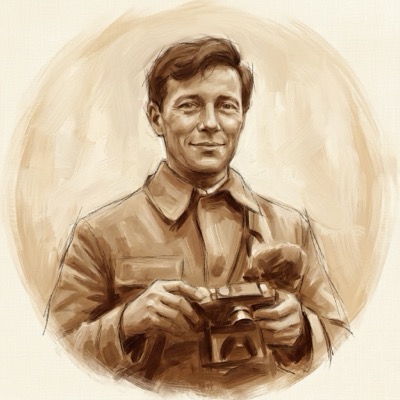
Michael Polanyi
KindredPhysical Chemist & Philosopher of Tacit Knowledge
A resonance, not a citation: Shipper does not name Polanyi. But his central claim — that stories and hands-on experience give us knowledge we 'may not be able to explicitly talk about, but we still know' — is close kin to Polanyi's tacit knowing, 'we can know more than we can tell.' Polanyi made the case against a fully explicit epistemology; Shipper thinks neural networks, 'the first technology we've ever invented that works a lot like human intuition', have built a working machine on the same premise.
youtube.com

