How does a mind know what matters?
The cuts

Relevance realization: a mind doesn't compute what matters, it continuously self-organizes toward it — trading generality against precision, staying poised between too much focus and too little. It's a standing act, not a rule you could write down.
Turned an unsolved AI problem into a research program in cognitive science — how a finite system sidesteps combinatorial explosion by realizing relevance rather than deriving it.
Relevance Realization and the Emerging Framework in Cognitive Science2012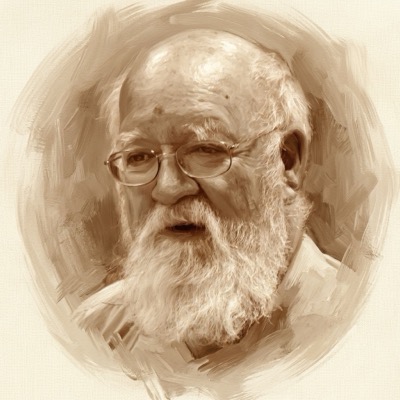
A robot that must check whether each fact is relevant before it acts never acts — it vanishes into an infinite lobby of considerations. Deciding what to ignore is the whole problem, and it is not obviously solvable by more computation.
Named the frame problem in a form everyone could feel: not how to reason, but how to know which tiny slice of everything is worth reasoning about at all.
Cognitive Wheels: The Frame Problem of AI1984
What matters is what carries the most information about reducing surprise. Precision-weighting is the brain's attention — the free-energy principle turned into a mechanism for allocating relevance moment to moment.
Gave relevance a possible physics: salience as precision, a quantity a system could actually compute while acting to stay in its expected states.
The free-energy principle: a unified brain theory?2010
What counts as relevant is set by the size of the self. A cell's 'what matters' is a chemical gradient; ours spans decades and continents. Relevance isn't universal — it's indexed to the scope of the cognitive light cone doing the caring.
Scaled the question below the human: every agent, down to a cell, faces its own frame problem, solved at the scale of the goals it can hold.
Technological Approach to Mind Everywhere (TAME)2022The tensions
Behind “what is intelligence?” sits a quieter, harder question. Out of the endless features of any situation, a mind attends to almost none — and somehow attends to the right ones. Dennett dramatized the difficulty: a robot that pauses to check whether each fact bears on its goal never finishes checking. Relevance can’t be derived fact by fact, because deciding which facts to consult is the very thing at issue.
Vervaeke’s answer is that relevance is not computed but realized — a finite system perpetually re-organizing itself toward what matters, balancing focus against openness, never settling because the situation never stops moving. Friston offers a candidate mechanism in the currency of surprise; Levin insists the whole thing is indexed to scale — a cell and a person each solve their own version, at the size of the goals they can hold.
What none of them claims is that the problem is finished. Whether relevance realization is one capacity or many, whether a system trained on text can do it without a stake in a world, and whether it is the same act in a cell and in a life — these stay open. The question is not answered here.