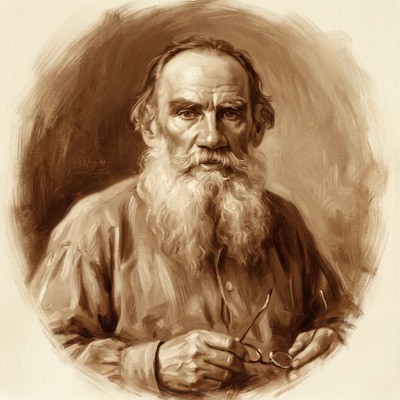
Leo Tolstoy
Novelist & Moral Philosopher
About
Leo Tolstoy (1828–1910) was a Russian novelist best known for War and Peace (1869) and Anna Karenina (1878), works often ranked among the greatest novels ever written. Following a moral and spiritual crisis in the 1870s, he turned toward Christian anarchism and pacifism, renouncing much of his earlier fiction as morally hollow. In the treatise What Is Art? (1897), he rejected definitions of art built on beauty or pleasure, arguing instead that art is the transmission of feeling: an artist calls up an emotion once experienced and communicates it to others through external signs so that they, too, come to feel it. He judged art's value by its 'infectiousness' and universality — its capacity to convey genuine, shared human feeling across class and culture — a standard by which he controversially dismissed even Shakespeare and Beethoven. His late writing on nonviolence, including correspondence with a young Gandhi, influenced 20th-century movements of nonviolent resistance.
Key Contributions
- Wrote War and Peace (1869) and Anna Karenina (1878), landmark works of world literature
- Argued in What Is Art? (1897) that art is the transmission of feeling from one person to another, not the pursuit of beauty
- Proposed 'infectiousness' and universality as the tests of genuine art, rejecting much celebrated art as insincere
- Developed a Christian anarchist and pacifist philosophy following his 1870s spiritual crisis
- Corresponded with a young Mohandas Gandhi, influencing the development of 20th-century nonviolent resistance