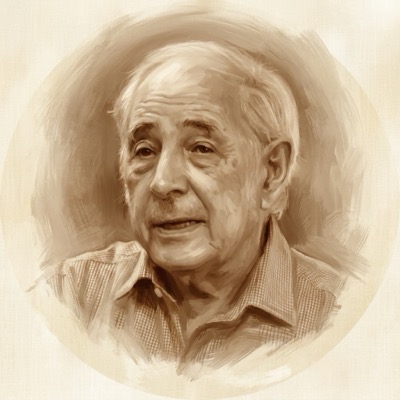
John Searle
Philosopher of Mind & Language
About
John Searle (b. 1932) is an American philosopher whose 1980 Chinese Room argument became the most-debated objection to machine understanding ever posed: a person following rules to manipulate Chinese symbols can pass for a speaker while understanding nothing, so syntax alone cannot produce semantics. Earlier, his work on speech acts showed how saying is a kind of doing. His 'biological naturalism' holds that consciousness is a real, causal, biological phenomenon — neither reducible to computation nor separate from the brain.
Key Contributions
- Posed the Chinese Room argument (1980), the canonical challenge to the claim that symbol manipulation amounts to understanding
- Developed speech act theory, showing how utterances perform actions rather than merely describe
- Articulated biological naturalism: consciousness as a causal, biological feature of brains
- Distinguished 'strong AI' from 'weak AI', vocabulary the debate still uses
- Kept the syntax/semantics distinction at the center of machine-understanding debates for four decades
Questions they sharpened View the streams
Videos & Interviews
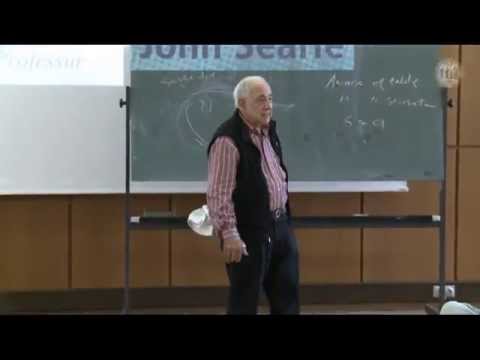
John Searle // Seminar: "Perception and Intentionality"
Searle's seminar from his 2013 Albertus Magnus Professorship at the University of Cologne, one of three themes he took up there alongside "Language and Social Ontology" and "Mind and Brain". The territory is his direct-realist account of perception: perceptual experience is intentional, its conditions of satisfaction are causally self-referential, and satisfying them means seeing the object itself rather than a picture of it. The material became *Seeing Things as They Are* (2015).
View Details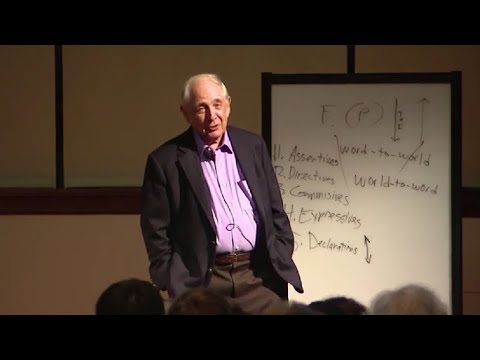
The Logical Structure of Human Civilization (John Searle)
In this Patten Lecture at Indiana University, Searle lays out his social ontology: money, property, marriage, and government exist only because we collectively declare them into being through speech acts. Human civilization, unlike animal society, is built and held together by linguistic representation with logical, propositional structure.
View DetailsPapers & Publications
Connections
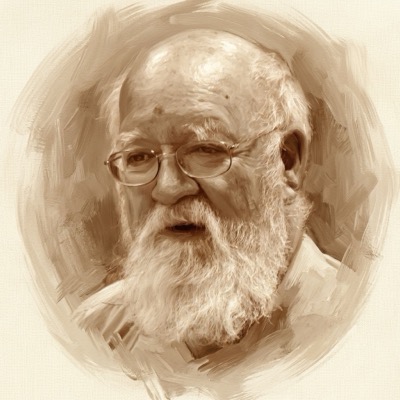
Daniel Dennett
DebatedPhilosopher & Cognitive Scientist
Their quarrel is the spine of the Chinese Room debate. Hofstadter and Dennett reprinted Searle's 1980 argument in The Mind's I with a rebuttal attached; Searle reviewed that book in the New York Review of Books and the two traded letters in 'The Myth of the Computer: An Exchange' (1982), and were still at it in 1995 over Consciousness Explained. Dennett calls the room an intuition pump that works only by getting you to imagine too simple a case; Searle answers that no quantity of syntax ever becomes semantics.
nybooks.com · nybooks.com · plato.stanford.edu
David Chalmers
DebatedPhilosopher of Mind
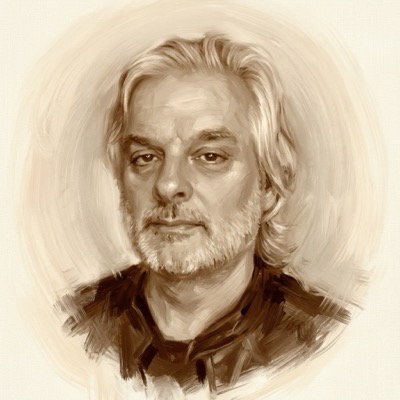
Searle reviewed The Conscious Mind in the New York Review of Books (March 1997) and called the position incoherent — property dualism bolted to functionalism, sliding toward panpsychism; Chalmers replied in the May exchange that he had explored panpsychism rather than endorsed it, and that dualism about properties leaves the question of substrate wide open. The stakes are machine-shaped: on Chalmers' view silicon is not ruled out, while for Searle consciousness is a biological achievement of brains.
nybooks.com · consc.net
Emily Bender
KindredComputational Linguist
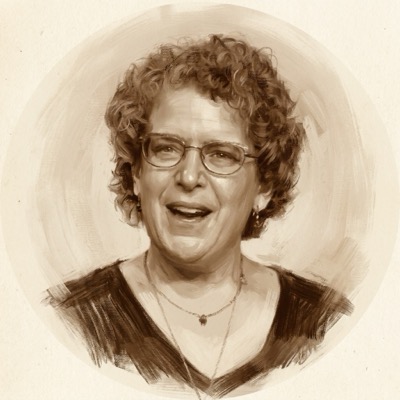
An interpretive pairing across forty years: Searle's Chinese Room and Bender's octopus both ask whether a system that manipulates symbols flawlessly has any purchase on what they mean. The difference is where each gets its force. Searle argues a priori, about intentionality and what a program could never in principle possess; Bender argues as a linguist about what a corpus of pure form can and cannot supply. One says the room could never understand; the other says nobody has shown where the meaning would get in.
Hubert Dreyfus
In contrastPhilosopher & AI Critic
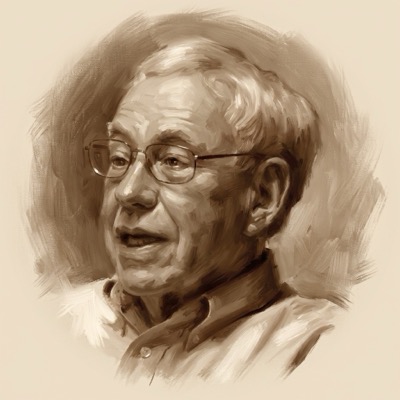
A reading of two Berkeley colleagues who attacked the same target from incompatible directions. Searle grants that a program might pass the Turing Test and denies it would understand anything — syntax never becomes semantics. Dreyfus denies the earlier step: a system fed only explicit rules could never cope well enough to get that far, because expertise is not rules. One argument concedes the behavior and withholds the mind; the other says the behavior was never coming.
plato.stanford.edu