
About
Felix Rieseberg is an engineer at Anthropic, where he created Claude Cowork and has led engineering for Claude.ai and for Claude Code on the desktop. He came to computing from poetry, then spent five years at Microsoft (2011–2016), first as a developer evangelist in Munich and San Francisco, then as an open-source engineer. He worked on Slack's desktop app from 2016 to 2021, on Stripe's payments APIs from 2021 to 2023, and led Notion's web infrastructure and desktop teams from 2023 to 2025. He has co-maintained Electron, the framework beneath many of today's AI desktop apps, since 2016. His side projects (Windows 95 and Mac OS 8 as desktop apps, Clippy running a local model, and Language Model Builder) aim to make computing and AI feel approachable rather than chase benchmarks.
Key Contributions
- Created Claude Cowork and led engineering for Claude.ai and Claude Code on the desktop at Anthropic
- Co-maintainer of Electron since 2016, the open-source framework behind Claude, Cursor, Codex and much everyday desktop software
- Built Language Model Builder, a free Mac app that explains how a language model works and then lets you train a small one in an afternoon
- Made the windows95 and macintosh.js apps and Electron Fiddle, playful tools that put old systems and new frameworks within anyone's reach
- Argues that understanding the mechanics is the way into the larger questions: moral patienthood, why models are grown rather than built, and what intelligence is
Videos & Interviews
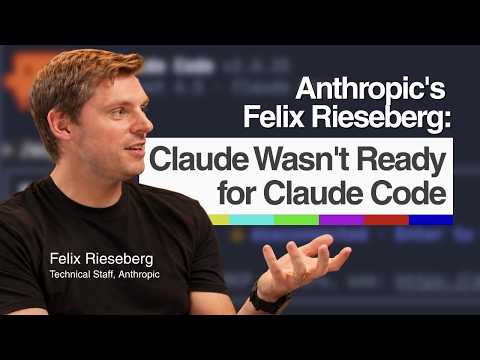
Use AI Like It's Already Superhuman | Felix Rieseberg
On MTS, Rieseberg discusses his essay "How to Be More Ambitious", a tutorial for humans working with models. He splits ambition into speed, altitude, depth and range, and argues that what impresses him is rarely what Claude can do but what the person driving it thought to ask. He calls the empty text box a genie in a bottle, and he won't add a "find a planet" button for every good use case. Instead he wants to nudge people toward ambition. He borrows from the IKEA effect and from marble that resists the chisel: authorship grows the more you engage, the way Rubens worked through a workshop of assistants. He dates Boris Cherny's first internal Claude Code demo to around September 2024, when the model was still a poor engineer. His lesson from that: ignore today's capabilities and ask what you would do if the thing were superhuman. He says management that tells people how to do their jobs no longer scales. The skills that transfer are empathy and turning what people want into requirements; arguments over tabs and spaces don't. He compares the moment to the camera and recorded music, which changed art without draining its value. People get most excited, he says, when AI does what they themselves can't.
View Details
Language Model Builder with Felix Rieseberg
On Hanselminutes, Rieseberg talks with Scott Hanselman about Language Model Builder, his free Mac app that teaches how a language model works and then has you train a small one yourself. Hanselman compares it to Ben Eater's build-a-computer-from-scratch videos. Rieseberg sized the app for a friend with one afternoon: a 10,000-token tokenizer, a model you can pretrain in about a day, and fine-tuning that needs only around 800 steps. One overnight model told him "the sun is a moon at the bottom of the earth." He lists the parts he likes best: the model blueprint, an "x-ray view" of the tokens the model didn't pick at each position, and a fine-tuning option that turns a group chat into a mimic of it. He came to computing from poetry. Looking at a model, he says, he gets the feeling he gets at a planetarium, as if the universe were staring back. Understanding the mechanics, he argues, is the way into the bigger questions, from moral patienthood to why researchers say they grow a model rather than build one.
View Details
