
關於
Felix Rieseberg 是 Anthropic 的工程師,打造了 Claude Cowork,並帶領 Claude.ai 與桌面版 Claude Code 的工程團隊。他從詩歌走進電腦世界,先在微軟待了五年(2011–2016),起初在慕尼黑與舊金山擔任開發者推廣,後來轉為開源工程師。2016 至 2021 年他在 Slack 負責桌面應用程式,2021 至 2023 年在 Stripe 參與核心支付 API,2023 至 2025 年帶領 Notion 的網頁基礎架構與桌面應用團隊。自 2016 年起,他共同維護 Electron——如今許多 AI 桌面應用都建在這個框架之上。他的業餘專案(做成桌面應用的 Windows 95 與 Mac OS 8、在本機跑語言模型的迴紋針 Clippy,以及 Language Model Builder)都想讓電腦與 AI 變得親近,而不是追逐跑分。
主要貢獻
- 在 Anthropic 打造 Claude Cowork,並帶領 Claude.ai 與桌面版 Claude Code 的工程
- 自 2016 年起共同維護 Electron,這個開源框架撐起了 Claude、Cursor、Codex 與許多日常桌面軟體
- 做出 Language Model Builder:一款免費的 Mac 應用,先講解語言模型如何運作,再讓你花一個下午訓練一個自己的小模型
- 做了 windows95、macintosh.js 與 Electron Fiddle,用好玩的工具讓舊系統與新框架人人都碰得到
- 主張理解機制才是通往更大問題的入口:道德受體地位、為什麼模型是「長」出來而非「造」出來的,以及智慧究竟是什麼
影片與訪談
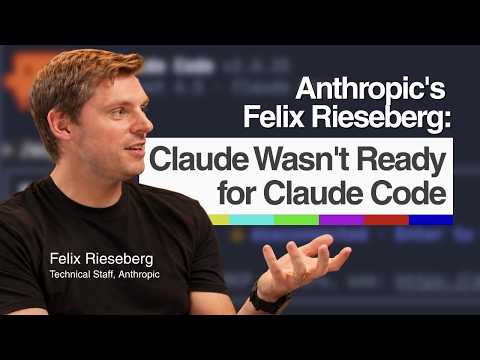
Use AI Like It's Already Superhuman | Felix Rieseberg
On MTS, Rieseberg discusses his essay "How to Be More Ambitious", a tutorial for humans working with models. He splits ambition into speed, altitude, depth and range, and argues that what impresses him is rarely what Claude can do but what the person driving it thought to ask. He calls the empty text box a genie in a bottle, and he won't add a "find a planet" button for every good use case. Instead he wants to nudge people toward ambition. He borrows from the IKEA effect and from marble that resists the chisel: authorship grows the more you engage, the way Rubens worked through a workshop of assistants. He dates Boris Cherny's first internal Claude Code demo to around September 2024, when the model was still a poor engineer. His lesson from that: ignore today's capabilities and ask what you would do if the thing were superhuman. He says management that tells people how to do their jobs no longer scales. The skills that transfer are empathy and turning what people want into requirements; arguments over tabs and spaces don't. He compares the moment to the camera and recorded music, which changed art without draining its value. People get most excited, he says, when AI does what they themselves can't.
View Details
Language Model Builder with Felix Rieseberg
On Hanselminutes, Rieseberg talks with Scott Hanselman about Language Model Builder, his free Mac app that teaches how a language model works and then has you train a small one yourself. Hanselman compares it to Ben Eater's build-a-computer-from-scratch videos. Rieseberg sized the app for a friend with one afternoon: a 10,000-token tokenizer, a model you can pretrain in about a day, and fine-tuning that needs only around 800 steps. One overnight model told him "the sun is a moon at the bottom of the earth." He lists the parts he likes best: the model blueprint, an "x-ray view" of the tokens the model didn't pick at each position, and a fine-tuning option that turns a group chat into a mimic of it. He came to computing from poetry. Looking at a model, he says, he gets the feeling he gets at a planetarium, as if the universe were staring back. Understanding the mechanics, he argues, is the way into the bigger questions, from moral patienthood to why researchers say they grow a model rather than build one.
View Details
