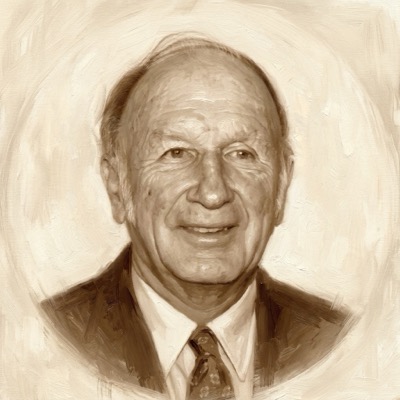
Edward Lorenz
Meteorologist & Founder of Chaos Theory, MIT
Trace a path from Edward Lorenz →Portrait painted after an image by AIP Emilio Segrè Visual Archives · Attribution
About
Edward Norton Lorenz (1917–2008) was an American mathematician and meteorologist at MIT whose work founded chaos theory. Running a simplified weather model on a Royal McBee LGP-30 in his office, he found that rounding one input changed the forecast entirely, and his 1963 paper 'Deterministic Nonperiodic Flow' showed that a fully deterministic system can still be practically unpredictable. A 1972 talk titled 'Does the Flap of a Butterfly's Wings in Brazil Set off a Tornado in Texas?' gave the idea its popular name, the butterfly effect. His programmers on that work included Ellen Fetter and Margaret Hamilton, who called working for him 'one of the best things I ever did.' He received the Crafoord Prize in 1983 and the Kyoto Prize in 1991.
Key Contributions
- Showed in 'Deterministic Nonperiodic Flow' (1963) that deterministic systems can be fundamentally unpredictable
- Gave the butterfly effect its name with his 1972 AAAS talk on predictability
- Discovered the Lorenz attractor, the emblematic image of chaotic dynamics
- Set a practical limit on weather forecasting of about two weeks, reshaping numerical prediction
- Crafoord Prize (1983) and Kyoto Prize (1991); wrote 'The Essence of Chaos' (1993)
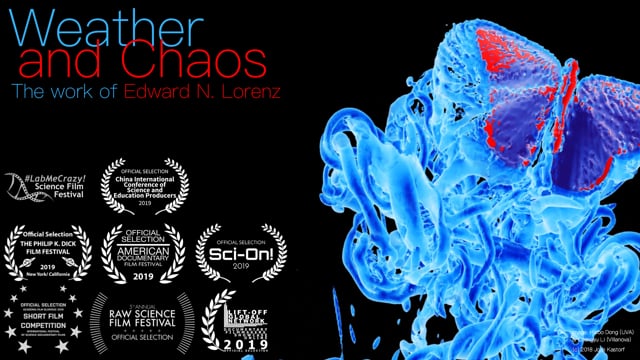
Videos & Interviews
Connections

Margaret Hamilton
InfluencedComputer Scientist & Software Engineering Pioneer
Her first job, in 1959, was programming Lorenz's weather models at MIT, on an LGP-30 in his office, before she had 'really been near a computer.' 'He taught me everything he knew about the LGP-30,' she remembered, and she called it 'one of the best things I ever did.' When she slipped back at four in the morning to fix a mistake she didn't want him to see, he worked it out the next day from the equations: where she had been, and what she had done.
youtube.com · en.wikipedia.org · news.mit.edu
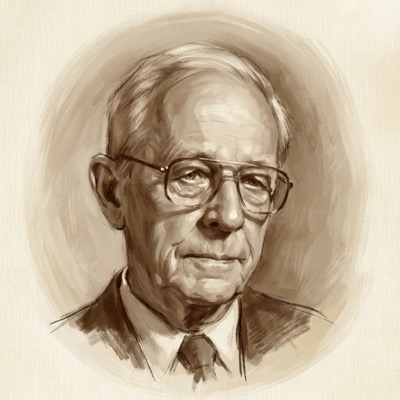
Jay Forrester
In contrastComputer Pioneer & Founder of System Dynamics, MIT
Two MIT men in the early 1960s, each running nonlinear feedback systems on early computers, drew opposite lessons from what they saw. Lorenz found that a deterministic system can be unpredictable in principle, so the forecast has a horizon no better model will pass. Forrester found that such systems are counterintuitive but can be modelled, so the right simulation could show a city or a planet where its levers really are. Read side by side, they bracket what anyone modelling a complex system today has to hold at once: how much can be known, and how much can still be steered.

