
Margaret Hamilton
Computer Scientist & Software Engineering Pioneer
Trace a path from Margaret Hamilton →About
Margaret Hamilton (1936–2026) was an American computer scientist who led the team that developed the on-board flight software for NASA's Apollo program. She began at MIT in 1959 writing weather-prediction software for Edward Lorenz, and at the Draper Laboratory began using the term 'software engineering' to give the discipline the same legitimacy as other engineering fields. Her rigorous approach to software design, including error detection and recovery, saved the Apollo 11 moon landing when the computer became overloaded minutes before touchdown. Her innovations in asynchronous software, priority scheduling, and human-in-the-loop decision making established foundational principles still used in safety-critical systems today. The Apollo story is rightly iconic, but it was a team's work, with more than 400 engineers under her direction, and popular retellings sometimes flatten the people and the hardware behind the landing. She died on 30 September 2026, aged 90.
Key Contributions
- Led MIT's Apollo flight-software team, treating software as mission-critical engineering before the field had that status
- Popularized 'software engineering' to argue that complex code deserved the same rigor and legitimacy as hardware engineering
- Built priority scheduling and error-recovery behavior into Apollo guidance software, helping Apollo 11 continue during computer overload alarms
- Turned human-in-the-loop safety and asynchronous software into practical design principles for critical systems
- Founded Hamilton Technologies and developed Universal Systems Language around a preventative, before-the-fact approach to systems design
Videos & Interviews

Connections
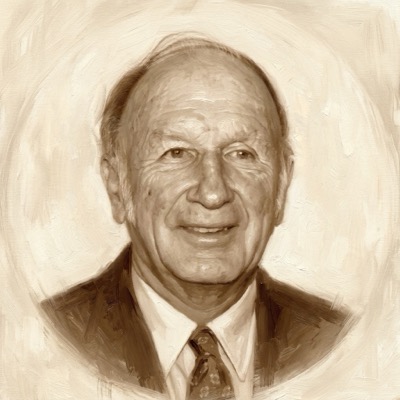
Edward Lorenz
Influenced byMeteorologist & Founder of Chaos Theory, MIT
Her first job, in 1959, was programming Lorenz's weather models at MIT, on an LGP-30 in his office, before she had 'really been near a computer.' 'He taught me everything he knew about the LGP-30,' she remembered, and she called it 'one of the best things I ever did.' When she slipped back at four in the morning to fix a mistake she didn't want him to see, he worked it out the next day from the equations: where she had been, and what she had done.
youtube.com · en.wikipedia.org · news.mit.edu
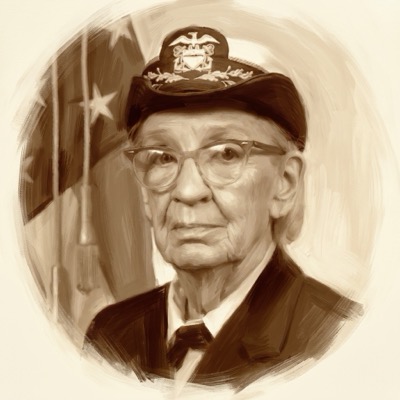
Grace Hopper
KindredComputer Scientist & Naval Rear Admiral
Neither woman invented software; each insisted it be taken seriously as something built. Hopper argued the machine should come toward human language and wrote the compiler that made the argument stick; Hamilton, a generation later, argued that code carrying human lives deserved the word 'engineering' and made it stick by landing on the Moon. Both were pushing against the same assumption — that the real work was the hardware.
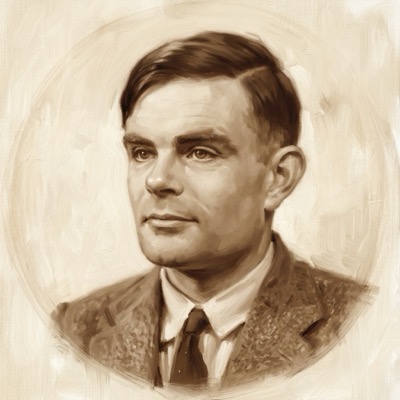
Alan Turing
KindredMathematician & Computer Science Pioneer
In 1949, at the conference launching Cambridge's EDSAC, Turing asked how anyone could make sure a routine is right, and answered that the programmer should make 'definite assertions which can be checked individually, and from which the correctness of the whole programme easily follows.' Hamilton reached the same conviction the hard way, through Apollo's errors, and built a company on it: define a system so completely that whole classes of mistakes can't be written. Read this way, both refused to treat correctness as something you find out after the code runs.
Alan Turing, Checking a Large Routine (1949) · arxiv.org · youtube.com

David Robinson
KindredFormer Safety Transparency Lead, OpenAI
Hamilton called the usual way of building software an 'after the fact life cycle', where you write it and then hunt the errors, 'like back in the old medical community where they didn't wash their hands.' Half a century later Robinson left OpenAI describing the same pattern in AI, 'shipping new capability and risk every Tuesday,' and asked that a release wait until its safety criteria are met, however long that takes. He also pointed to the Challenger launch, where the risk 'had been known and documented and accepted.' One pairing, read across fifty years: safety is a property you design in, not one you discover after release.
youtube.com · youtube.com · youtube.com

