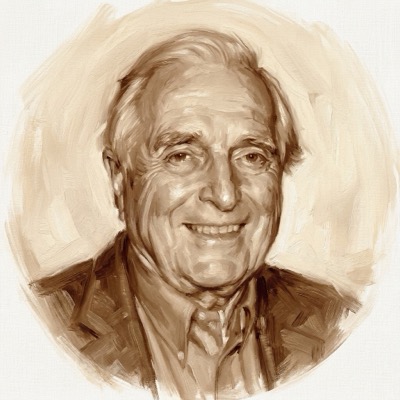
Douglas Engelbart
Engineer & Pioneer of Human Augmentation
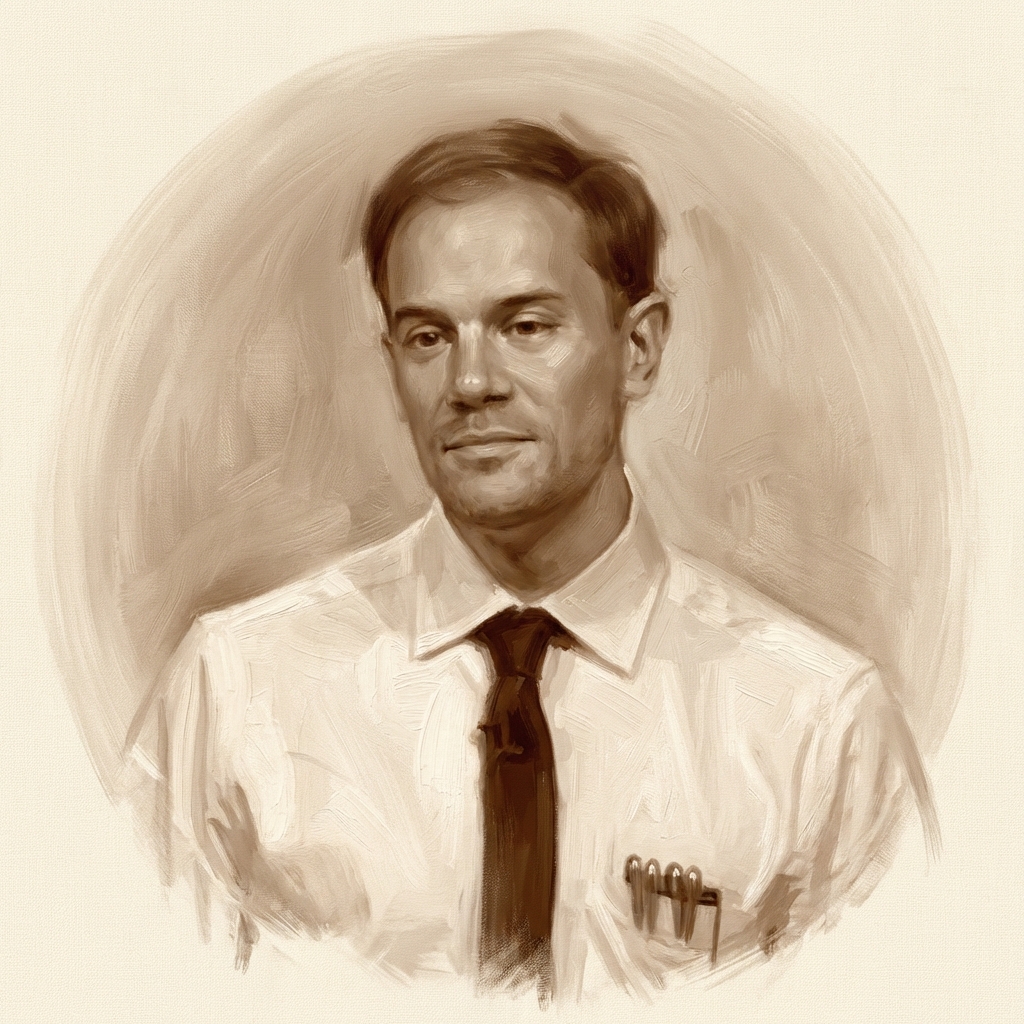
Trace a path from Douglas Engelbart →Portrait painted after an image by Alex Handy · CC BY-SA 2.0
About
Douglas Engelbart (1925–2013) was an American engineer who spent his working life on one question: how computers could augment human intellect, helping people think together about problems too complex for any one mind. At the Stanford Research Institute he founded the Augmentation Research Center, and in 1962 he set out its program in 'Augmenting Human Intellect: A Conceptual Framework.' On 9 December 1968 he and his team gave the live demonstration later called 'The Mother of All Demos': the mouse, hypertext links, real-time collaborative editing and shared-screen video conferencing, all running on their oN-Line System (NLS). His lab became the second node of the ARPANET in 1969, and he received the 1997 Turing Award and the 2000 National Medal of Technology.
Key Contributions
- Set out the augmentation program in 'Augmenting Human Intellect' (1962): computers as instruments for thinking, not only for calculating
- Founded SRI's Augmentation Research Center, where NLS joined hypertext, outlining, and real-time collaborative editing in one system
- Invented the computer mouse, built by Bill English and patented in 1970 as an 'X-Y position indicator for a display system'
- Gave the 1968 'Mother of All Demos', showing in ninety minutes most of what personal and networked computing would become
- Ran the ARPANET's second node and its first Network Information Center at SRI from 1969
- Is remembered for the mouse rather than the mission: the goal he named, raising humanity's collective IQ, is still mostly unbuilt
Videos & Interviews
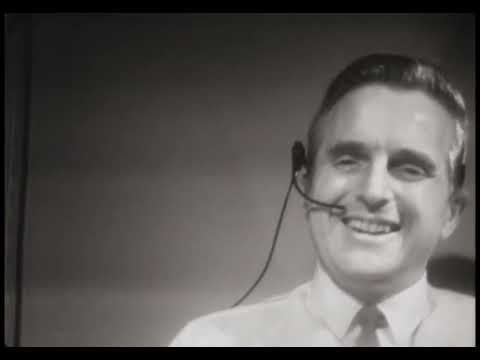
1968 "Mother of All Demos" with Doug Engelbart & Team (1/3) [re-mastered]
Engelbart's 9 December 1968 presentation at the Fall Joint Computer Conference in San Francisco, the first part of three, remastered in 2022 by Stanford Libraries from the original film reels: the mouse, hypertext links, real-time collaborative editing and shared-screen video, all running live on NLS.
View Details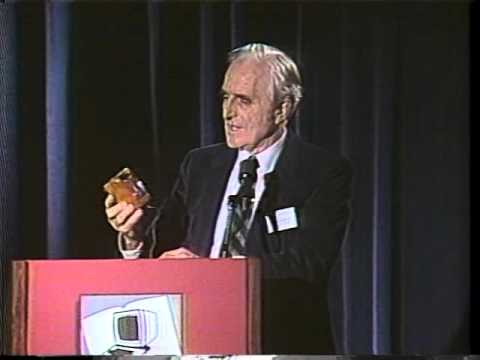
Doug Engelbart, "The Augmented Knowledge Workshop"
Engelbart's talk at the 1986 ACM Conference on the History of Personal Workstations, looking back on the augmentation program and what his SRI team set out to build.
View DetailsPapers & Publications
Connections
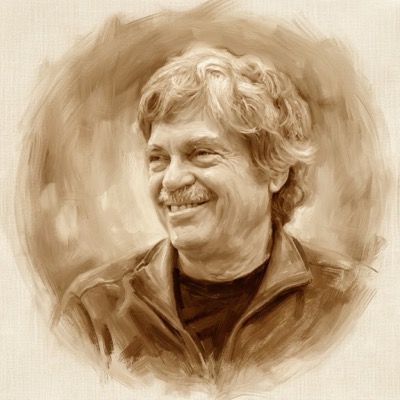
Alan Kay
InfluencedComputer Scientist & Personal Computing Pioneer
Kay met NLS in 1967, a year before the famous demo: Engelbart came to Utah with his own 16mm projector while Kay was designing the FLEX machine, and Kay writes that he 'immediately adopted many of the ideas.' He called Engelbart 'a prophet of Biblical dimensions', and at Xerox PARC it was Engelbart's people, Bill English above all, who helped him start his group. Then he turned away on one point: after watching children program in LOGO, he decided the computer should be not Engelbart's 'personal dynamic vehicle' but a medium, and a medium 'had to extend into the world of childhood.'
worrydream.com · en.wikipedia.org
Bret Victor
InfluencedInterface Designer & Computing Visionary
The day after Engelbart died, Victor wrote that the obituaries had him wrong: crediting him with the mouse 'is as if you found the person who invented writing, and credited them for inventing the pencil.' What Engelbart had was an intent, to augment human intellect, and Victor's homepage names him among the few suppliers of his own mission: mind as toolkit, externally. Dynamicland, the lab Victor co-founded, calls itself a research group 'in the spirit of Doug Engelbart and Xerox PARC', and carries the collaboration Engelbart showed in 1968 off the screen and into a shared room.
worrydream.com · worrydream.com · dynamicland.org

Maggie Appleton
InfluencedStaff Research Engineer, GitHub Next
In 'Tools for Thought as Cultural Practices, not Computational Objects', Appleton makes Engelbart's 1962 report a touchstone of the community she writes for, and keeps the distinction most readers drop: he cared about our ability to deal with complex problems, not about 'amplifying intelligence' — winning a chess match looks intelligent but helps with no wicked problem. She also keeps the half of his program that the gadgets made people forget, that organisational structures, system dynamics and training were part of the puzzle. That half is her thesis: tools for thought are practices people grow, not apps they install.
maggieappleton.com

