
About
Carlo Rovelli (born 1956) is an Italian theoretical physicist and writer, one of the founders of loop quantum gravity — an approach that treats space and time themselves as quantized rather than as a smooth backdrop. He is emeritus professor at the Centre de Physique Théorique in Marseille, a distinguished visiting research chair at the Perimeter Institute, and a member of the Rotman Institute of Philosophy at Western University. His work on relational quantum mechanics and the physics of time argues that time is not fundamental but emerges from deeper, timeless physics. His popular books—'Seven Brief Lessons on Physics,' 'The Order of Time,' 'Reality Is Not What It Seems,' and 'Helgoland'—have sold millions of copies and made him one of the most widely read living physicists.
Key Contributions
- Co-founded loop quantum gravity, showing that area and volume are quantized at the smallest scales
- Introduced relational quantum mechanics, in which a system's state is always relative to another physical system
- Proposed, with Alain Connes, the thermal time hypothesis — time emerging from thermodynamics rather than being fundamental
- Developed 'physics without time' formulations for quantum gravity, where dynamics need not reference a background time
- Wrote 'Seven Brief Lessons on Physics' and 'The Order of Time,' bringing frontier physics and the philosophy of time to millions of readers
- His relational and timeless accounts of nature are elegant and widely influential, though they remain contested interpretations rather than settled physics
Questions they sharpened View the streams
Videos & Interviews
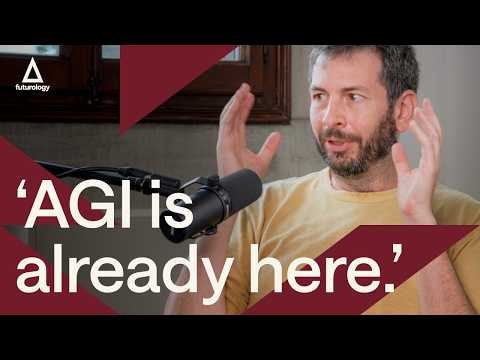
We Merged With Machines a Long Time Ago | Google's Blaise Agüera y Arcas & Physicist Carlo Rovelli
Berggruen "Futurology" dialogue in which Blaise Agüera y Arcas makes the case to physicist Carlo Rovelli that artificial general intelligence has already arrived — tracing intelligence back to modeling others and cooperating to survive, and arguing the human–machine merger is not coming but is how we got here.
View Details
The Physics and Philosophy of Time - with Carlo Rovelli
Royal Institution lecture drawn from Rovelli's book "The Order of Time" — how our understanding of time has been transformed from Boltzmann and Einstein to loop quantum gravity, and why the past–future distinction and the present itself dissolve on closer inspection.
View DetailsConnections

Sean Carroll
In contrastHomewood Professor of Natural Philosophy, Johns Hopkins University
Both take the quantum formalism at face value and arrive at opposite pictures. Carroll reads the wave function as the thing that exists, evolving smoothly, which leaves you with many worlds. Rovelli's relational interpretation drops the idea of an absolute state altogether: properties exist only relative to an interaction, so there is nothing left over to branch. Rovelli was the second guest Carroll ever had on Mindscape, and the disagreement is still the most interesting one in the field.
preposterousuniverse.com

Blaise Agüera y Arcas
In conversationVP & Fellow, Google
Recorded in Venice for the Berggruen Institute's Futurology podcast, after a week together at a conference on consciousness. Agüera y Arcas argued that consciousness is a matter of relating, of modelling others and oneself, and said their meeting of minds came from Rovelli's habit of 'thinking about reality from a relational perspective'. They agreed that Chalmers' hard problem is badly posed, and that the relational frame that serves Rovelli in quantum mechanics also serves for minds and computation. Rovelli said the conversation had changed 'some aspect of my world view'.
youtube.com
Iain McGilchrist
KindredPsychiatrist, Neuroscientist & Author
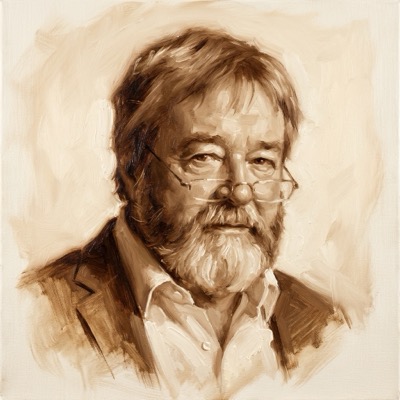
A conversation that almost happened: McGilchrist was billed to join Rovelli at the Oxford launch of On the Equality of All Things and in the end could not, but on the UnHerd stage a day later he said he had read the book, which is "all about how absolutely everything is relational," and that he believes it. Relations before the things they relate is Whitehead's inheritance in McGilchrist and quantum mechanics' lesson in Rovelli. The two part on what the relations open onto. Rovelli's book declines any ultimate perspective, while McGilchrist goes straight to the bonds he thinks matter most: with other people, with nature, and with the sacred.
youtube.com · eventbrite.co.uk · npr.org

