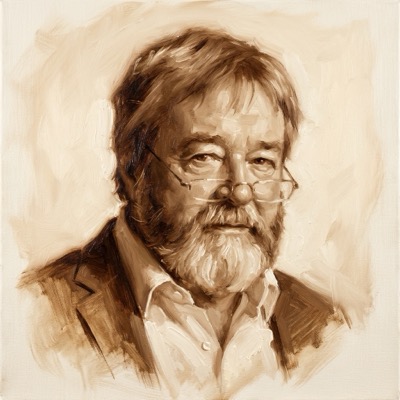
Iain McGilchrist
Psychiatrist, Neuroscientist & Author
About
Iain McGilchrist is a psychiatrist, neuroscience researcher, and literary scholar, best known for his landmark book 'The Master and His Emissary' on brain hemisphere lateralization. His work argues that the left and right hemispheres offer fundamentally different ways of attending to the world—the left focused on manipulation and control, the right on understanding context and interconnection. His framework offers profound implications for understanding AI, which he sees as embodying a dangerously one-sided, left-hemisphere mode of cognition.
Key Contributions
- Wrote 'The Master and His Emissary,' reframing hemispheric lateralization as two modes of attention, not pop left-brain/right-brain clichés
- Brought together psychiatry, neuroscience, literary scholarship, and philosophy rather than treating brain lateralization as a narrow lab topic
- Expanded the argument in 'The Matter with Things,' linking neuroscience, philosophy, and metaphysics
- Critiques modern culture's preference for abstraction, control, and mechanism over context, relation, and lived presence
- Applies that critique to AI as an extreme case of disembodied, instrumental, left-hemisphere-style cognition
- His synthesis is ambitious and resonant, though critics dispute how far neuroscience can support the cultural diagnosis
Videos & Interviews
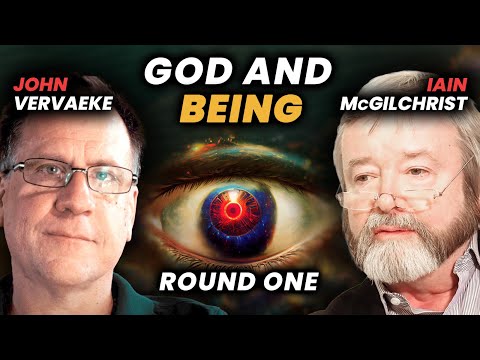
Iain McGilchrist & John Vervaeke: God, Being, Meaning
Deep dialogue on consciousness, meaning, and the nature of reality
View Details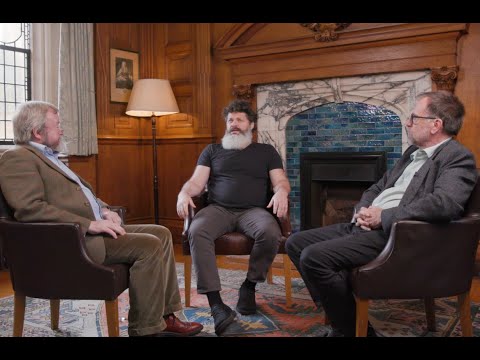
The Psychological Drivers of the Metacrisis: John Vervaeke, Iain McGilchrist, Daniel Schmachtenberger
Trilogue on the deep psychological and cognitive roots of civilizational challenges
View Details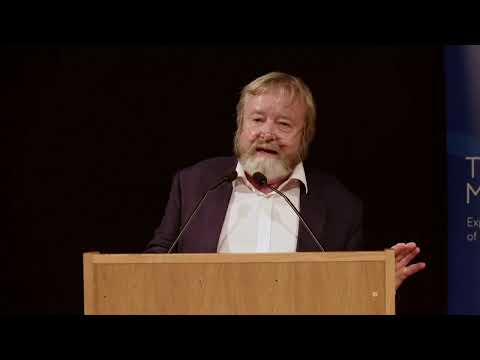
The Triumph of the Machine - Lecture Two from The Future of Humanity
McGilchrist examines how mechanistic thinking has come to dominate modern civilization and what this means for our future
View Details
Why Evolution Gave You Two Brains
McGilchrist explains the fundamentally different ways our two hemispheres attend to the world
View DetailsConnections

John Vervaeke
In conversationCognitive Scientist & Philosopher
Vervaeke and McGilchrist have made their dialogue a running institution — two of the conversations are on this site, from 'God, Being, Meaning' to the psychological drivers of the metacrisis. What keeps them talking is a shared diagnosis reached by different instruments: attention is not a spotlight but a way of loving the world, and a culture that optimizes it for grasping loses what can only be met.
youtube.com

Curt Jaimungal
In conversationFilmmaker; Host of Theories of Everything
A second sitting rather than a first: Jaimungal had already given McGilchrist an episode on The Master and His Emissary, and brought him back for The Matter with Things alongside John Vervaeke. Convening two people who work the same seam — attention as the thing that makes a world — is a different editorial act from booking a guest, and this episode is the clearest instance of it on his channel.
youtube.com

David Abram
KindredCultural Ecologist & Philosopher
An interpretive pairing: both diagnose modernity as a mode of attention that flattens a living world into usable abstraction — McGilchrist through hemispheric asymmetry, Abram through the history of writing. Different instruments, same warning about what a culture stops perceiving.

Dana Gioia
KindredPoet & Critic; Former Chairman, National Endowment for the Arts
McGilchrist gives a neurological frame to what Gioia argues as a poet-critic: that poetry is language attended to as music, gesture, and embodied meaning, and that a culture which treats poems as puzzles to decode has handed the art to its narrower faculty. Gioia's ten observations on what poetry is read like field notes for McGilchrist's central claim — that some things appear only to a certain kind of attention.