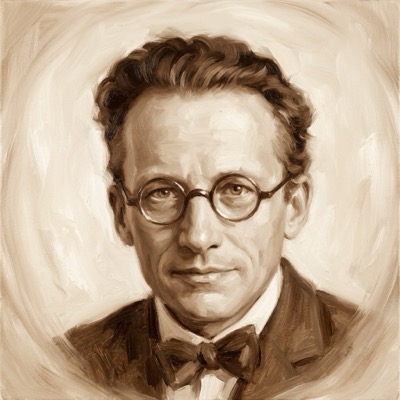
Schrödinger, a physicist, asks how the orderly, predictable behavior of a living organism can be reconciled with the statistical laws that govern ordinary matter. His answer is that heredity must be carried by a stable, non-repeating molecular structure — what he calls an “aperiodic crystal” — years before DNA’s structure was known, and that living things stay ordered by continuously drawing “negative entropy” from their surroundings rather than decaying toward equilibrium like everything else.
The book is a landmark less for getting biology right in every detail than for treating life as a matter of pattern and code rather than of any special substance. That move — mind and life as information organized in matter — is the same one cognitive science and AI would later take as a starting assumption.