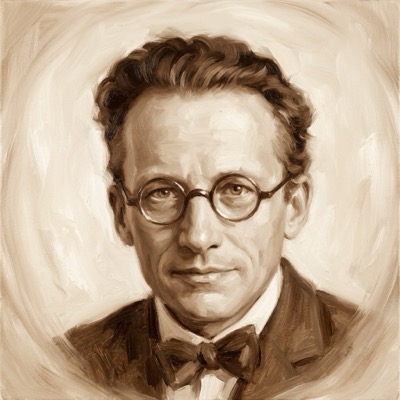
Erwin Schrödinger
Physicist & Nobel Laureate
About
Erwin Schrödinger (1887–1961) was an Austrian physicist and a founder of quantum mechanics, awarded the 1933 Nobel Prize in Physics (shared with Paul Dirac) for the wave equation that bears his name. Beyond the Schrödinger equation and the famous cat thought experiment, his most consequential contribution to the questions this project circles is a small 1944 book, What Is Life?, based on lectures in Dublin. In it he asked how living matter maintains order against the pull of entropy, proposed that heredity is stored in an 'aperiodic crystal,' and coined the idea of life feeding on 'negative entropy.' The book directly inspired James Watson and Francis Crick, helping launch molecular biology.
Key Contributions
- Formulated the Schrödinger equation (1926), a cornerstone of quantum mechanics
- Shared the 1933 Nobel Prize in Physics with Paul Dirac
- Devised the Schrödinger's cat thought experiment and coined 'entanglement'
- Wrote What Is Life? (1944), reframing life as a physics problem of order and negentropy
- Predicted an 'aperiodic crystal' as the carrier of heredity, inspiring the discovery of DNA's structure