
John Maeda
CVP Engineering, GitHub Design & Microsoft CoreAI Design
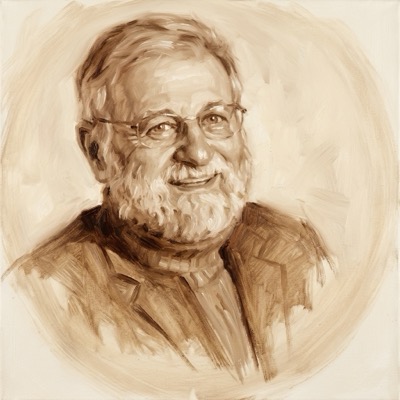
Trace a path from John Maeda →Portrait painted after an image by Fuzheado · CC BY 4.0
About
John Maeda is a designer and computer scientist who has spent his career arguing that design and engineering are one discipline. Born in Seattle in 1966, he grew up working in his father's tofu shop, studied computer science at MIT, and earned a PhD in design from Tsukuba University. Over twelve years at the MIT Media Lab he led the Aesthetics + Computation Group, making early computational art now in MoMA's permanent collection. He went on to serve as president of the Rhode Island School of Design (2008–2013), design partner at Kleiner Perkins, chief experience officer at Publicis Sapient and CTO of Everbridge, and is now corporate vice president of engineering for GitHub Design and Microsoft CoreAI Design. His books include The Laws of Simplicity (2006) and How to Speak Machine (2019), and his annual Design in Tech Report has tracked how computation reshapes the design profession.
Key Contributions
- Wrote The Laws of Simplicity (2006), ten laws for making designs simpler that became a touchstone across product design
- Led the MIT Media Lab's Aesthetics + Computation Group, pioneering computational and generative art now held by MoMA
- Wrote Design By Numbers (1999), teaching programming to visual artists, and How to Speak Machine (2019), on computation's laws for non-engineers
- Served as the 16th president of the Rhode Island School of Design (2008–2013), arguing for STEM to become STEAM
- Received the National Design Award (2001) and the AIGA Medal (2010)
- Created the Design in Tech Report, bringing design's role in the technology industry to investors and engineers
Videos & Interviews

Connections
Don Norman
In conversationDirector of The Design Lab, UC San Diego
In 2012 PARC put the two on one stage for a dialogue on design and innovation, and Norman's own write-up records the result: he wanted to talk about complex design, interaction and planning, while Maeda, then president of RISD, wanted to talk about the beauty of fonts, of knives, of the office chair. 'So we failed to connect.' Fourteen years later Maeda closed a talk on AI and product design with Norman's gulfs of execution and evaluation, arguing that agents collapse the first and make the second the whole job, which reads like the conversation finally arriving where Norman wanted it.
jnd.org · goodreads.com · youtube.com

Bret Victor
In contrastInterface Designer & Computing Visionary
Read as a quarrel inside one family. Maeda's Design By Numbers (1999) brought visual artists to code by keeping the language tiny, and his students Casey Reas and Ben Fry grew it into Processing, the tool through which a generation of designers first programmed. In 'Learnable Programming' (2012) Victor took Processing as his case against the way programming is taught, finding its ellipse 'exactly as cryptic as assembly language', because people understand what they can see. One asked artists to meet the machine halfway; the other asked the machine to come the rest of the way.

Maggie Appleton
KindredStaff Research Engineer, GitHub Next
A pairing about software made for one occasion. Maeda builds a new presentation system for every talk he gives, the latest in a weekend with speech-to-text and live interpretation, and shrugs that 'we all can do this now'; Appleton's 'home-cooked software' describes apps made like meals, for the people you know, by barefoot developers that language models might finally equip. He is the professional for whom the cost of a bespoke tool fell to nearly nothing; she asks who else that fall could reach.

