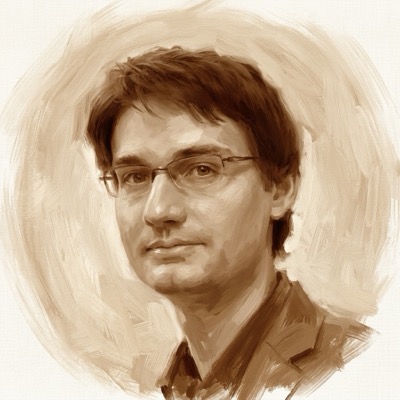
François Chollet
AI Researcher & Creator of Keras
About
François Chollet (b. 1989) is a French AI researcher, creator of the Keras deep-learning framework, and author of 'On the Measure of Intelligence' (2019), which redefined intelligence as skill-acquisition efficiency: the ability to handle problems you were never trained on, rather than accumulated performance. To make the definition testable he created ARC, a benchmark of novel abstraction puzzles that resisted the field's best systems for years while other benchmarks saturated. After a decade at Google he co-founded Ndea in 2024 to pursue AGI research guided by that definition, and co-launched the ARC Prize.
Key Contributions
- Created Keras, one of the most widely used deep learning frameworks
- Redefined intelligence as skill-acquisition efficiency in 'On the Measure of Intelligence' (2019)
- Built the ARC benchmark — novel tasks outside every training distribution — to make the definition operational
- Co-founded the ARC Prize, making resistance-to-memorization a public research target
- Co-founded Ndea (2024) to pursue program-synthesis routes to general intelligence
Questions they sharpened View the streams
Papers & Publications
Connections

John McCarthy
In contrastComputer Scientist & Father of AI
Both wrote a definition of intelligence that shaped everything after it, and the two definitions are near opposites. McCarthy's Dartmouth proposal held that every aspect of intelligence can in principle be described precisely enough for a machine to simulate it — a premise that founded a field by quietly assuming its problem away. Chollet's is a refusal of that exact move: intelligence is not any specifiable skill but the efficiency of acquiring skill on problems the specification never anticipated. Seventy years apart, they are the two poles of this site's question 'What is intelligence?'.

Gary Marcus
KindredCognitive Scientist, AI Critic & Author
Two versions of one objection, in different registers. Marcus argues in essays and books that deep networks lack robust abstraction and will keep breaking outside their training distribution; Chollet built a benchmark instead — ARC, made of tasks no training set contains — that turned the same claim into something a lab could fail at in public. Read together they show the difference between a critique that scores points and one that hands the other side a clean way to prove you wrong.

John Vervaeke
In contrastCognitive Scientist & Philosopher
This site's question 'Can intelligence be measured?' sets them directly against one another. Chollet's answer is yes, if you measure the right thing — skill-acquisition efficiency on tasks no training set contains, which is what ARC exists to do. Vervaeke's is that any fixed benchmark has already told the system what counts as a task, while general intelligence is precisely the power to reframe: to decide, unprompted, what the task even is. The disagreement is not about how hard the test should be but about whether a test can be the right instrument at all.

Melanie Mitchell
KindredProfessor, Santa Fe Institute
Two generations of the same bet: that abstraction and analogy are the core of intelligence, and that systems without them will keep failing in revealing ways. Mitchell built Copycat in the 1980s to model analogy-making as perception; Chollet built ARC decades later as a benchmark of exactly the abstraction Copycat pursued. Neither thinks scale alone gets there — and both have spent years being told the next model will prove them wrong.