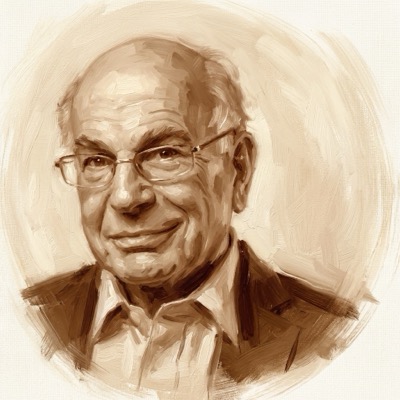
Daniel Kahneman
Psychologist & Nobel Laureate
About
Daniel Kahneman (1934–2024) was an Israeli-American psychologist and Nobel laureate whose work on cognitive biases and decision-making transformed our understanding of human rationality. His collaboration with Amos Tversky produced prospect theory, which earned him the 2002 Nobel Prize in Economics. His bestselling book 'Thinking, Fast and Slow' introduced the dual-process framework of System 1 (fast, intuitive) and System 2 (slow, deliberate) thinking—a model that has become central to understanding both human cognition and AI system design. His research on heuristics, biases, and the limits of human judgment offers essential context for evaluating AI systems that increasingly augment or replace human decision-making.
Key Contributions
- Developed prospect theory with Amos Tversky, explaining systematic departures from expected-utility rationality
- Won the 2002 Nobel Memorial Prize for bringing psychological evidence into economic decision theory
- Wrote Thinking, Fast and Slow, popularizing heuristics, biases, and dual-process thinking for a broad audience
- Studied happiness, experienced utility, and the focusing illusion, extending decision research into well-being
- Changed how designers, policymakers, and AI researchers think about judgment, uncertainty, and human error
- His framework is influential but sometimes overapplied; parts of the heuristics-and-biases literature also faced replication and interpretation debates
Videos & Interviews

Daniel Kahneman: Thinking Fast and Slow, Deep Learning, and AI | Lex Fridman Podcast #65
Deep conversation on dual-process cognition, the limits of human intuition, and the implications of AI for decision-making
View Details
Thinking, Fast and Slow | Daniel Kahneman | Talks at Google
Kahneman presents the core ideas of his landmark book on the two systems of thought
View Details