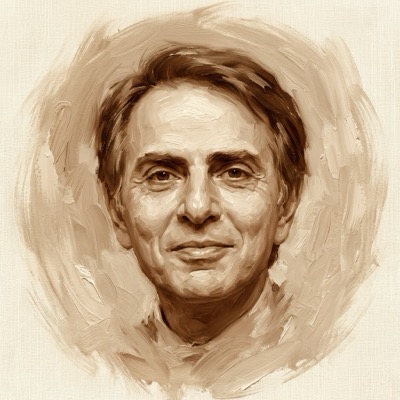
About
Carl Sagan (1934–1996) was an astronomer, cosmologist, and one of the greatest science communicators in history. His TV series 'Cosmos' and books like 'The Demon-Haunted World' inspired millions to embrace scientific thinking. While he worked before the modern AI era, his emphasis on critical thinking, skepticism, and the search for extraterrestrial intelligence (SETI) raised fundamental questions about the nature of intelligence and our place in the universe—questions that resonate deeply with today's AI debates.
Key Contributions
- Created and hosted Cosmos, setting a standard for science communication as wonder joined to evidence
- Helped advance planetary science through work on Venus, Mars, Titan, and NASA mission imaging teams
- Pioneered SETI advocacy and designed the Pioneer plaque and Voyager Golden Record as messages across cosmic time
- Helped bring nuclear-winter arguments into public debate, linking planetary science to civilization-scale risk
- Wrote The Demon-Haunted World, defending scientific skepticism against pseudoscience and wishful thinking
- His eloquence made science humane and cosmic, though critics sometimes saw his public celebrity as oversimplifying scientific uncertainty
Videos & Interviews

Carl Sagan - A Way of Thinking
Sagan discusses critical thinking and the scientific method
View Details
Carl Sagan - Pale Blue Dot
Sagan's famous reflection on humanity's place in the cosmos
View Details
Contact
The 1997 film based on Sagan's novel, exploring first contact with extraterrestrial intelligence
View DetailsConnections
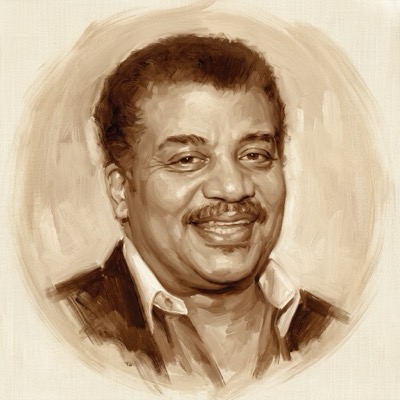
Neil deGrasse Tyson
InfluencedAstrophysicist & Director, Hayden Planetarium
Cornell's admissions office forwarded the seventeen-year-old Tyson's application to Sagan, who wrote back and invited him to Ithaca for a Saturday. Tyson chose Harvard, but kept the lesson: 'I already knew I wanted to become a scientist. But that afternoon, I learned from Carl the kind of person I wanted to become.' Thirty-four years after the original, he hosted Cosmos: A Spacetime Odyssey and told that story on air.
en.wikipedia.org · Neil deGrasse Tyson, The Sky Is Not the Limit (2000) · Cosmos: A Spacetime Odyssey, episode 1 (2014)
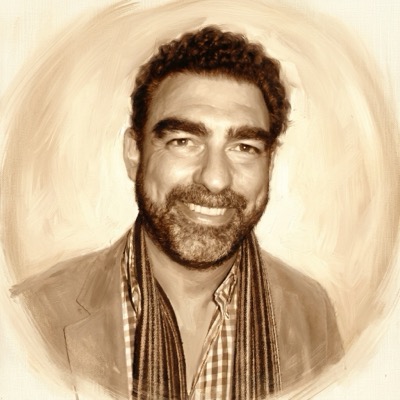
Nick Lane
In contrastEvolutionary Biochemist, UCL
Lane finds it almost disturbing how strongly the chemistry favours life, which sounds like Sagan's universe until you hear where he stops. He is happy to grant that life starts readily wherever there is rock, water, and a gradient — that much may be close to inevitable. What he refuses is the next step, the cosmological view in which life then rolls on to complexity, intelligence, and us. Earth ran two billion years of bacteria before anything more happened, and only one merger ever broke the deadlock. A lovely thought, Lane says of the smooth ascent, and not what the record shows.
youtube.com · youtube.com

