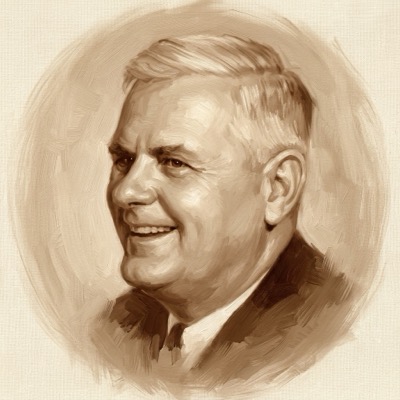
Alonzo Church
Mathematician & Logician
關於
Alonzo Church (1903–1995) was an American mathematician and logician who, working at Princeton, gave one of the two foundational definitions of computation. His lambda calculus captured the notion of an effectively calculable function through pure symbol substitution, and in 1936 he proved that the Entscheidungsproblem — Hilbert's dream of a general decision procedure for mathematics — has no solution. That same year, independently, Alan Turing reached the same boundary with his imaginary machines; their equivalence became the Church–Turing thesis, the bedrock claim about what computation is. Turing came to Princeton as Church's doctoral student. Church later held the Flint Professorship at UCLA (1967–1990).
主要貢獻
- Created the lambda calculus, a foundational model of computation still central to computer science
- Proved the undecidability of the Entscheidungsproblem (1936), independently of Turing
- Co-originated the Church–Turing thesis on the limits of effective computation
- Supervised Alan Turing's doctoral work at Princeton
- Founded the Journal of Symbolic Logic and shaped modern mathematical logic
論文與出版物
思想連結
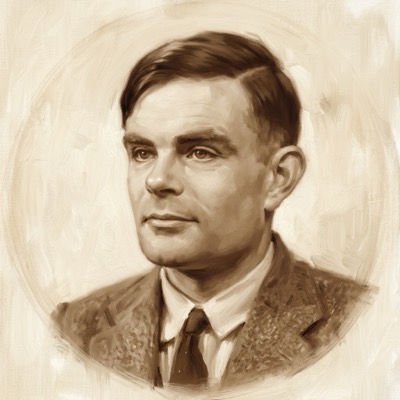
艾倫·圖靈
影響了他/她數學家與電腦科學先驅
1936 年圖靈來到普林斯頓,在 Church 門下寫他的博士論文——而 Church 正是那個以完全不同路徑、比他略早抵達同一道邊界的人。Church 的 λ 演算把計算定義為純粹的代換,圖靈的機器則把它定義為一位帶著紙帶的抄寫員。兩者最終被證明描述了完全相同的一類程序,這就是邱奇—圖靈論題,也是電腦科學最接近自然律的東西。
plato.stanford.edu · en.wikipedia.org · On Computable Numbers, with an Application to the Entscheidungsproblem (1936)
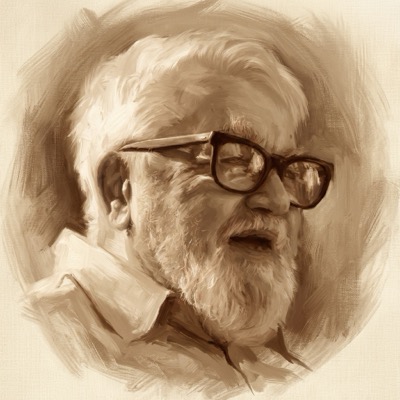
約翰·麥卡錫
影響了他/她電腦科學家與 AI 之父
Lisp 的 lambda 直接來自 Church,而麥卡錫說得很坦白:「使用 Church(1941)的 λ 記法似乎很自然。他書中其餘的部分我看不懂,所以也就不會想去實作他那套更一般的函數定義機制。」一位邏輯學家用來定義函數的演算,就這樣以一種被借用者自承「只借了一半」的方式,變成了可執行的程式構造。AI 第一個語言有一半血統,來自 1936 年一項關於數學極限的證明。
www-formal.stanford.edu · www-formal.stanford.edu