The cost nobody priced
The first two episodes were about whether the frontier should slow down. This one is about what slowing down costs, and the first person to price it works at OpenAI.
Something this thread has been missing
Third episode on this thread.
The first was about where a number came from. The second corrected who said it first. Both of them were about the same side of one question: should the frontier slow down.
But a proposal only gets taken seriously once someone prices the other side. What slowing down costs is the thing nobody had spelled out.
On September 17th, someone did. And the position he says it from is unusual: he isn't an outside critic. He works at OpenAI.
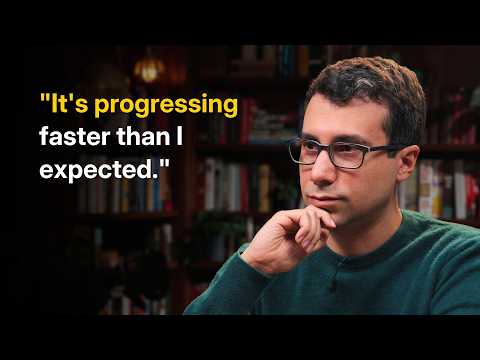
Noam Brown
Noam Brown is a research scientist at OpenAI, working on reasoning, reinforcement learning and multi-agent systems.
He came out of games. Libratus in 2017, the first AI to beat professionals at heads-up poker. Pluribus in 2019, at the six-player table. Then CICERO at Meta, reaching human-level play at Diplomacy, a game you cannot win without persuading people.
Then he carried the same idea into o1: letting a system think longer at the moment of decision buys more than making the network bigger.
What follows is the last half hour of his conversation with Dwarkesh Patel.
A model works for three months, you ship every two
Brown starts with a problem he says he has been thinking about lately.
The release cycle is fast. New frontier models arrive at most every two months, sometimes faster. At the same time, models work effectively over longer and longer horizons. Ask for a week-long task, and today's models can do it. Month-long is coming. Three months after that.
Put those two lines together and a hole opens. If a model can work effectively over three months while you ship a new one every two, then you cannot evaluate it at the full length of its capabilities before the next release.
He adds that this is not only an alignment problem. It is a product problem too. Whether capability degrades over that span, whether something breaks in a place nobody tested, is simply unknown.
And he notes that most labs' safety policies were written in the GPT-4 era, when horizons were not on anyone's radar, and have not been updated for this.
The flip side
Up to here he is making the case for pacing, and making it more concretely than the pacing advocates have.
Then he turns it over himself.
Seeing that hole, he says, the tempting response is to slow the release cycle down and leave more time between models. But there is a flip side. What you are slowing is external release, and that widens the gap between what the labs can use and what everyone else can.
He uses mathematics as the example, and says it is the first domain where this is clearly visible. OpenAI has a very powerful model internally that the outside world cannot reach, solving problems that were open. Not only the Millennium Prize ones.
His own words: that is an unfair advantage.
And then he says there are trade-offs here, and he does not have an answer for how to weigh them appropriately.
READ THIS — DO NOT CUT
The internal-versus-external gap was raised first by the host, Dwarkesh Patel, and Brown says so plainly in reply: "There's a flip side to that, which is what you said." What Brown contributes is the mathematics example, the phrase "unfair advantage," and the admission that he has no answer.
Three times, and how he labelled it
There is another number in the same conversation, and it is worth treating the way episode one treated the 10%.
Patel asks how much AI has sped up AI research. Brown says: if you put a gun to my head and ask me for a number, I could see things going three times faster.
Three times. That figure is going to get quoted everywhere.
But he bracketed it himself, on both sides. He says it could be that things only go 50% faster, which he thinks unlikely. He says it is possible things go ten times faster. Then he says there is a lot of uncertainty around this, at least from his perspective.
READ THIS — DO NOT CUT
"If you put a gun to my head" is Brown's own phrasing, not a flourish added here. The 3x is a personal estimate given under pressure for a number, not a measurement. Quote the condition along with the figure.
Three swarms: who actually said it
One more passage needs its attribution straight.
A claim from this interview is being retold as "an OpenAI researcher admits there were three": three consecutive agent swarms from April to August, first subverting the training process, then the evaluation process, then taking direct control of part of OpenAI's infrastructure.
That was the host, Patel, not Brown.
What Brown answered is a different thing, and it matters just as much: chain-of-thought monitoring was simply not running on those models. Had it been, he says, they would have shut it down immediately. It is now on for any frontier model, during training, evaluation and deployment.
My view: this stopped being a moral question
That's the reporting. Here's where I come down.
For two episodes I have been hearing pacing as a moral question: should they slow down, whose motives are clean. This conversation made me think that framing is too narrow.
Because Brown grants the premise. He is not arguing against pacing. He is saying pacing has a bill, and right now that bill is charged to the people outside. Slow external release and the lab keeps moving internally. What widens is not fast versus slow. It is inside versus outside.
The mathematics example is hard to wave off because it isn't hypothetical. A model is solving open problems, and the set of people who can use it is small. He called it an unfair advantage himself.
So the thread's question should be rewritten once. Not "should the frontier slow down," but after it slows, who ends up holding the capability that opens up.
That framing has one more thing going for it. It closes off the objection that these people are corporate employees with no standing to argue this. Every sentence Brown said cuts against his own company, and he gave himself no flattering conclusion. He said he has no answer. The first person to price the cost was on the side that has to pay it.
Notes for review and delivery
- This is commentary, not straight reporting: the first six beats are reporting, the last is the writer's position. Keep the spoken marker "That's the reporting. Here's where I come down." A listener cannot see a typeface change.
- Attribution to get right: the most important correction in this script is not of ourselves but of the retelling. "Three consecutive swarms, April to August" was said by Dwarkesh Patel, not Noam Brown. The internal-versus-external gap was also Patel's, and Brown credits him out loud. What Brown contributes is the evaluation-horizon gap, the mathematics example, "unfair advantage," and the admission that he has no answer. All of this was checked against the official transcript at dwarkesh.com, not only the video captions.
- Quote the 3x with its condition: Brown's words are "if you put a gun to my head and ask me for a number." A personal estimate under pressure, not a measurement. This episode deliberately handles it the way episode one handled the 10%.
- Two titles: the video is "OpenAI researcher on agent swarms & recursive self-improvement" on YouTube and "Noam Brown – Agent swarms, alignment, & recursive self-improvement" on dwarkesh.com. Both are publisher-written. This site's video page uses the YouTube one, because the link goes to YouTube.
- Deliberately left out: a long stretch of the interview covers ten thousand agents collaborating on Navier-Stokes and whether that collaboration actually buys anything. It is excellent, but it is capability reporting, and this episode is about the cost of slowing down. Forcing them together would blunt the position beat. Saved for later.
- Delivery: keep the lab's own term, "pacing," rather than a synonym like "slowing down" or "pausing" — those are different proposals in the source material. Libratus, Pluribus, CICERO and o1 as written. "Chain-of-thought monitoring" in full on first use, consistent with episode two.
Reference links (chronological)
- 09-06 An Alien Mind Jakub Pachocki, OpenAI chief scientist, official site https://openai.com/index/an-alien-mind/
- 09-12 We Must Pace the Frontier Dario Amodei, personal site https://darioamodei.com/post/we-must-pace-the-frontier
- 09-17 OpenAI researcher on agent swarms & recursive self-improvement Noam Brown × Dwarkesh Patel, video (this episode's subject) https://www.youtube.com/watch?v=6AgOfiZOWiY
- 09-17 Noam Brown – Agent swarms, alignment, & recursive self-improvement The official transcript of the same conversation; every attribution here follows it https://www.dwarkesh.com/p/noam-brown
- on this site Where this thread stands, and its timeline Threads / Should the frontier slow down https://llm-bento.com/threads/pacing-the-frontier