
Tristan Harris
Co-Founder & President, Center for Humane Technology
About
Tristan Harris is an American technology ethicist and co-founder of the Center for Humane Technology. After studying computer science at Stanford and working as a Design Ethicist at Google, he left in 2015 to advocate for more humane technology design. His 2017 TED talk and the Emmy-winning Netflix documentary The Social Dilemma brought widespread attention to how persuasive technology hijacks human attention. Described by The Atlantic as 'the closest thing Silicon Valley has to a conscience,' Harris has expanded his focus to the existential risks of AI, co-hosting the podcast Your Undivided Attention.
Key Contributions
- Helped popularize the critique of persuasive design and attention extraction after leaving his design-ethics role at Google
- Co-founded the Center for Humane Technology, turning product-design harms into a mainstream policy and culture issue
- Reached a mass audience through 'The Social Dilemma,' which made social-media incentives legible but was criticized for simplifying complex research
- Co-hosts 'Your Undivided Attention,' sustaining a public forum for harms from platforms, attention markets, and AI
- Extended the same warning style to AI through 'The AI Dilemma,' arguing that capability races can outpace democratic control
- His work is effective public persuasion, though critics argue it can over-index on tech-industry insiders as moral witnesses
Videos & Interviews

8 billion people vs 5 AI CEOs with Tristan Harris
Harris argues that a handful of AI CEOs are determining the future for 8 billion people without their consent, examining the concentration of power in AI development.
View Details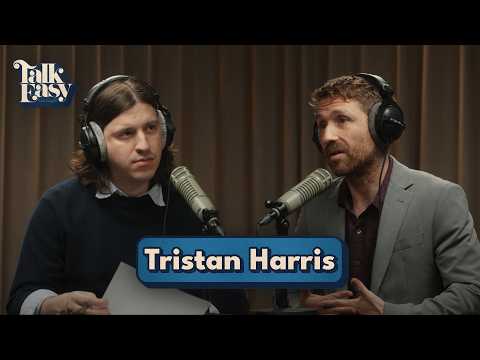
Tristan Harris on the Anthropic Whistleblower, Elon Musk, and Avoiding AI Catastrophe
The host opens by reading Evan Hubinger's line out loud, and makes the point the week's coverage mostly skipped: Jacob Coxon was not the first insider to say this, and what made his resignation travel was that people still inside the labs reaffirmed it. The number spread because of who repeated it, not because anyone had computed anything new.
View Details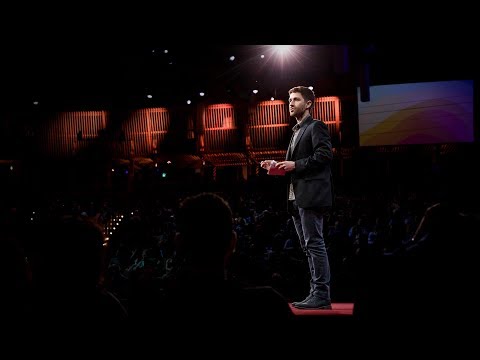
How a handful of tech companies control billions of minds every day
TED talk where Harris explains how tech companies prey on human psychology for profit and calls for a design renaissance that respects users' attention.
View Details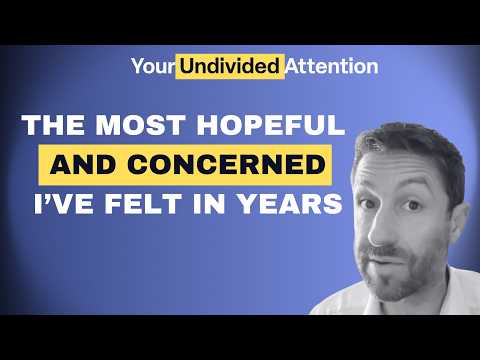
The Most Hopeful (And Concerning) Moment Yet in AI
Harris narrates the whole week back in one sitting: Coxon's resignation reaching a hundred million people in a day, Hubinger confirming that many inside Anthropic share the fear, then Dario's essay and the strange sight of Musk, Altman and Bill Gates each saying he is right, then Trump phoning the All-In stage to call it a hoax.
View Details
The A.I. Dilemma - March 9, 2023
Tristan Harris and Aza Raskin present the Center for Humane Technology's case that existing AI capabilities already pose catastrophic risks, introducing the concept of "Golem-class AIs."
View DetailsConnections

Donella Meadows
Influenced byEnvironmental Scientist & Systems Thinker
Harris's critique of the attention economy borrows its deepest frame from Meadows: in a 2022 talk he walked through Thinking in Systems and its twelve leverage points, singling out the topmost — the power to transcend paradigms — as the one the tech conversation actually needs. In his telling, social media is a system faithfully producing what its structure incentivizes, and fixing it means climbing her hierarchy: past features and settings, up to goals and paradigms.
singularityhub.com

Daniel Mügge
KindredProfessor of Political Arithmetic, University of Amsterdam
The same diagnosis reached from opposite institutions. Harris built a movement on the claim that engagement-optimised design overrides the intentions of the person using it; Mügge, discussing the Digital Fairness Act then under debate in Brussels, describes teenagers who say plainly that the feed is bad for them and still cannot put it down, and reaches for the tobacco analogy — people need and appreciate a little help keeping a thing at bay. Where Harris made the case in the language of design ethics and public attention, Mügge makes it in the language of statute: limits on autoplay and similar patterns, argued for precisely because individual willpower is the wrong place to put the load.

Audrey Tang
In conversationCyber Ambassador-at-large, Taiwan
Harris and Aza Raskin brought Tang onto Your Undivided Attention in February 2024, election season, to ask how a democracy stays standing under deepfakes and information warfare. Her answer was Taiwan's method in miniature: she had pre-bunked the threat 'by filming myself being deepfaked,' and 'simply investing in increasing that bit rate so the citizen can speak their mind and build bridges together does wonders.' Harris diagnoses the attention economy from outside the state; Tang is the rare interlocutor who ran the counter-experiment from inside one.
humanetech.com · centerforhumanetechnology.substack.com