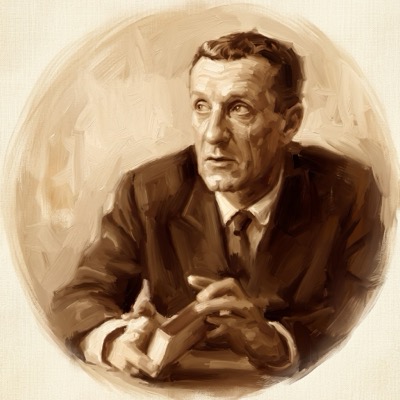
Maurice Merleau-Ponty
Phenomenologist & Philosopher
About
Maurice Merleau-Ponty (1908–1961) was a French phenomenologist philosopher whose work on perception and embodiment has become foundational to critiques of disembodied AI. His major work 'Phenomenology of Perception' argues that the body is not merely a physical object but the primary subject of perception—we understand the world through our bodily engagement with it, not through abstract representations. His concept of 'motor intentionality' and the lived body profoundly influenced Hubert Dreyfus's critique of symbolic AI, and his ideas anticipate modern debates about whether AI systems can truly understand without embodiment.
Key Contributions
- Wrote 'Phenomenology of Perception,' making the lived body central to perception and meaning
- Developed motor intentionality, showing that skilled action can be intelligent without explicit representation
- Argued that perception is active bodily engagement with the world, not detached internal reconstruction
- Extended phenomenology into language, art, politics, and the unfinished ontology of 'The Visible and the Invisible'
- Influenced embodied cognition, enactivism, and Dreyfus's critique of disembodied symbolic AI
- His prose and concepts are difficult, but that difficulty guards against simplistic claims that intelligence is just representation processing
Connections
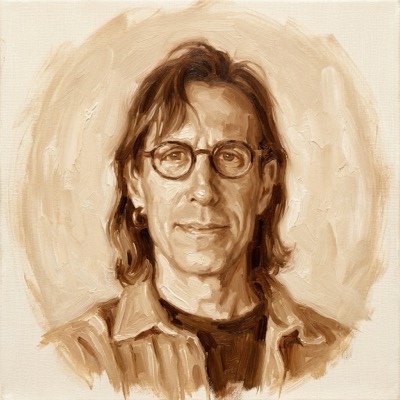
David Abram
InfluencedCultural Ecologist & Philosopher
Abram built The Spell of the Sensuous directly on Merleau-Ponty's phenomenology of perception — taking his account of the body's silent conversation with things and extending it beyond the human, to landscape, weather, and animal life. His doctoral dissertation used Merleau-Ponty's phenomenology as its method, and his 1988 essay 'Merleau-Ponty and the Voice of the Earth' laid the book's groundwork.
davidabram.org · Merleau-Ponty and the Voice of the Earth, Environmental Ethics 10 (1988) · en.wikipedia.org
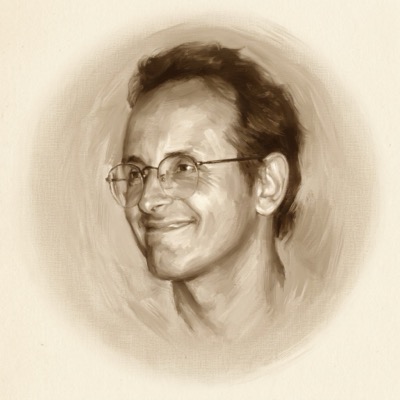
Francisco Varela
InfluencedBiologist, Philosopher & Neuroscientist
The Embodied Mind opens its first chapter, 'A Fundamental Circularity,' on Merleau-Ponty: we reflect from inside a world that seemed to be there before reflection began, and is not separate from us. Varela turned that circle into a method — neurophenomenology, which pairs disciplined Husserlian and Merleau-Pontian description with neural measurement instead of treating first-person experience as noise to be averaged out.
en.wikipedia.org · The Embodied Mind (MIT Press, 1991), ch. 1 — 'A Fundamental Circularity'