
Diogo Almeida

Diogo Almeida

Founder & CEO, TypeSafe AI

About

Diogo Almeida is the founder and CEO of TypeSafe AI, and was the fourth author on InstructGPT (2022), the OpenAI paper that made RLHF the standard way a language model is turned into an assistant. He worked on the post-training behind ChatGPT and GPT-4, and was at Google Brain before that. He now argues that the technique he helped build is what holds automation back. RLHF optimises for human preference, and a reward model can detect visible uncertainty far more easily than it can check whether an answer is correct — so the objective rewards sounding confident. On his account hallucination is not a defect waiting to be patched but the objective working as specified, and the assistance era that followed ChatGPT was a "weird detour" away from software that does real work. TypeSafe's answer is RLCD, reinforcement learning for calibrated decisions, and a model called Jev that returns a typed value with a probability attached instead of prose.

Key Contributions

  • Fourth of twenty authors on InstructGPT (2022), the paper that made RLHF the standard method for turning a language model into an assistant
  • Worked on the post-training behind ChatGPT and GPT-4 at OpenAI, after Google Brain
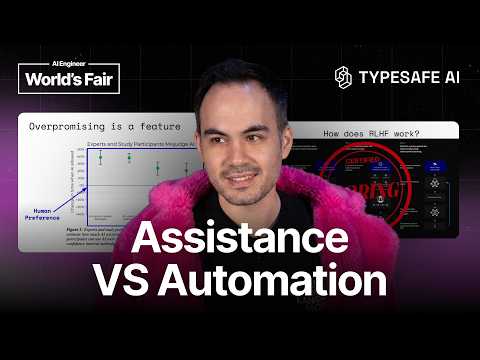
  • Argues that RLHF's preference objective makes hallucination intrinsic rather than incidental: a reward model detects visible uncertainty far more easily than it verifies correctness, so training rewards confident delivery
  • Separates post-training into three branches by what each optimises for — RLHF for human preference, RLVR for pure correctness, and TypeSafe's RLCD for calibrated decisions
  • Calls the assistance era after ChatGPT a "weird detour" from real automation, arguing that SaaS has barely changed since 2019 except for a chatbot latched onto the side
  • Founded TypeSafe AI and launched Jev (September 2026), which returns a value matching a schema defined in advance, with what the lab calls a calibrated probability, rather than free text

Moments Timeline View all moments

Sep 2026

Jev and System One Models

TypeSafe AI, after two years in stealth, publishes Jev along with a name for the category it claims to have opened: System One Models. The pitch is a change of contract rather than a change of substrate. Where a language model takes a prompt and returns free text one token at a time, Jev takes an input and a schema and returns a value of that type with a calibrated probability attached, in what the lab calls a single query. Founder Diogo Almeida — fourth of twenty authors on InstructGPT, the paper that made RLHF standard — frames it as a third branch of post-training, sorting the field by what each objective optimises for: RLHF for human preference, RLVR for pure correctness, and TypeSafe's RLCD for calibrated decisions. His argument is that preference optimisation makes hallucination intrinsic, because a reward model can detect visible uncertainty far more easily than it can verify correctness, so the training rewards confident delivery. The intelligence underneath is still pre-trained: Almeida calls pre-training "phenomenal" and says the problem is "how we unearth it", describing the method as mainlining the intelligence of pre-trained models into something useful for software. Whose base model, and whether TypeSafe pre-trained it themselves, is not disclosed, along with parameter count and context window. Jev's own figures are TypeSafe's, measured by TypeSafe on an early-access model released the same day: responses of 70 to 500 milliseconds, and $0.042 per million input tokens with output free. The 3-to-329-second frontier-model range they are set against is not theirs — it is lifted from a third-party benchmark site. And the 0% hallucination rate is not a measurement at all: the lab says plainly that the number "is not empirical", and that guaranteed schema matching is what lets them put a zero on the chart. It describes conformance to a schema, not truth. Early access is open; no independent numbers have been published.

Videos & Interviews

Papers & Publications

Theme
Language
Support
© funclosure 2025