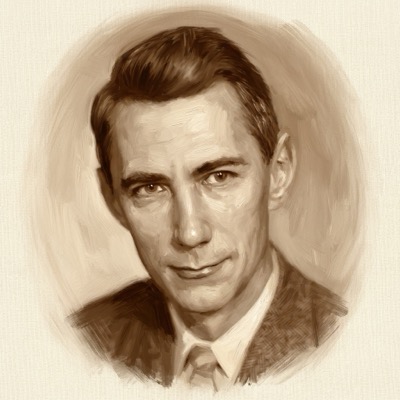
Claude Shannon
Mathematician & Father of Information Theory
About
Claude Shannon (1916–2001) was an American mathematician and engineer who founded information theory with his landmark 1948 paper 'A Mathematical Theory of Communication.' His work provided the theoretical basis for digital computing and communication, defining the 'bit' as the fundamental unit of information. Shannon showed that information could be quantified, transmitted, and processed—concepts that underpin everything from the internet to modern AI. His work on chess-playing machines and maze-solving robots also made him a pioneer in artificial intelligence.
Key Contributions
- Used Boolean algebra to analyze switching circuits, helping connect logic, electronics, and digital computation
- Founded information theory with the 1948 paper 'A Mathematical Theory of Communication'
- Made bits, entropy, channel capacity, and noise precise engineering concepts for communication systems
- Helped found modern cryptography with work on secrecy systems and the mathematical limits of secure communication
- Built playful but serious machines, including chess programs and the maze-solving mouse Theseus, that anticipated AI experimentation
- His abstraction of information deliberately ignored meaning — powerful for engineering, but a limit when imported too casually into minds and language
Questions they sharpened View the streams
Videos & Interviews

Claude Shannon - Father of the Information Age
Documentary on Shannon's life and revolutionary contributions to computing
View Details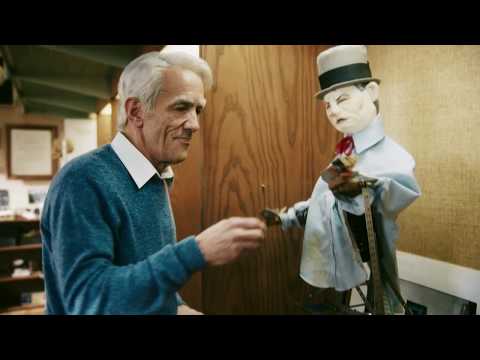
Claude Shannon - The Bit Player (Movie Trailer)
Trailer for the documentary exploring Shannon's playful genius and lasting impact
View Details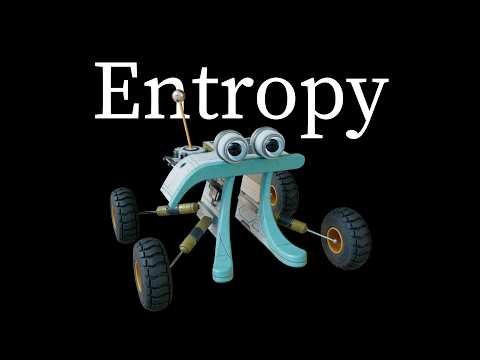
Reinventing Entropy | Compression is Intelligence Part 1
Grant Sanderson explores Shannon entropy, compression, and the link between information theory and intelligence.
View DetailsPapers & Publications
Connections
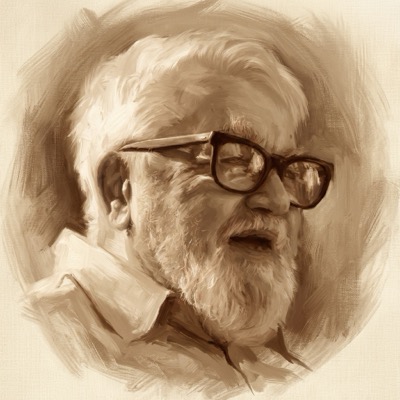
John McCarthy
CollaboratedComputer Scientist & Father of AI
Before the field had a name, McCarthy and Shannon co-edited Automata Studies (1956), a volume that put von Neumann on building reliable organisms from unreliable parts beside a run of papers on Turing machines. That same year the two of them, with Minsky and Rochester, signed the Dartmouth proposal where the phrase 'artificial intelligence' first appears — Shannon listed at Bell Telephone Laboratories, offering to apply information theory to computing machines and brain models. The literature came first; the name arrived within the year.
www-formal.stanford.edu · en.wikipedia.org · Automata Studies, Annals of Mathematics Studies 34, Princeton University Press (1956), eds. C. E. Shannon & J. McCarthy
Alan Turing
In conversationMathematician & Computer Science Pioneer
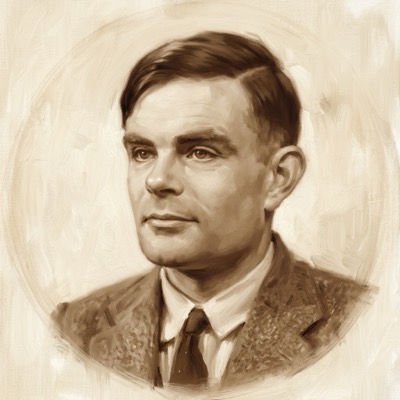
Early in 1943 Turing was in America — naval cryptanalysis in Washington, speech encipherment at Bell Labs — and for two months he and Shannon met at teatime in the cafeteria. Turing showed him the 1936 paper defining the universal machine, and Shannon found many of its ideas ran alongside his own. Two of the century's foundational abstractions, computation and information, recognizing each other over tea.
en.wikipedia.org · Andrew Hodges, Alan Turing: The Enigma (1983)
John von Neumann
KindredMathematician & Computer Architecture Pioneer
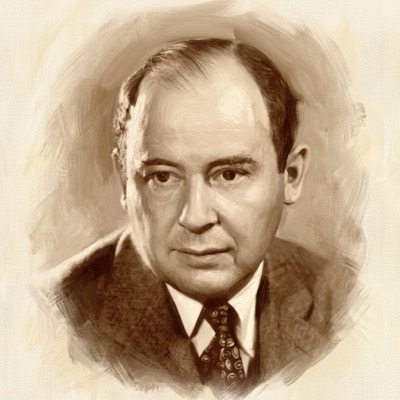
Von Neumann's chapter in the volume Shannon co-edited asked how reliable organisms can be synthesized from unreliable components — which reads as the machine-shaped form of the question Shannon had already answered for messages, showing that redundancy can carry meaning intact through a noisy channel. Taken together they mark the moment engineering stopped treating error as failure and began treating it as a quantity to be budgeted. Modern machine learning lives entirely inside that shift.
Automata Studies, Annals of Mathematics Studies 34 (1956) — von Neumann, 'Probabilistic Logics and the Synthesis of Reliable Organisms from Unreliable Components', pp. 43–98