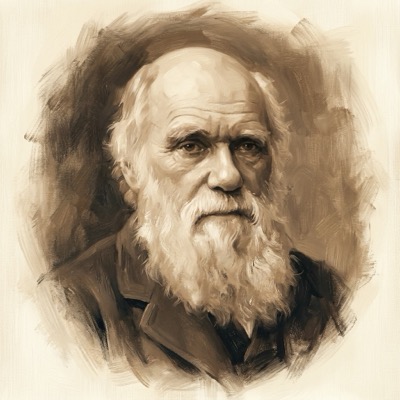
Charles Darwin
Naturalist & Originator of Evolution by Natural Selection
About
Charles Darwin (1809–1882) sailed aboard HMS Beagle from 1831 to 1836 as the captain's gentleman companion and the voyage's naturalist, then spent the next two decades gathering evidence for — and postponing — the argument that voyage had made unavoidable. On the Origin of Species (1859) proposed that the fit between a creature and its world needs no designer: heritable variation, more offspring than can survive, and differences in who survives are enough, given time, to raise structures of extraordinary intricacy out of no foresight at all. He published only after Alfred Russel Wallace independently derived the same mechanism, forcing a joint presentation to the Linnean Society in 1858. The Descent of Man (1871) placed humans inside that account rather than above it, and The Expression of the Emotions in Man and Animals (1872) gave feeling itself a natural history. His idea is the one this field keeps borrowing: Dennett named it cranes rather than skyhooks, and the labs betting that intelligence must be grown rather than engineered — open-ended search, quality-diversity, the Darwin Gödel Machine — are all wagering that Darwin described the only process ever known to have produced a mind.
Key Contributions
- Published On the Origin of Species (1859), arguing that heritable variation and differential survival alone produce adaptation — natural selection, design without a designer
- Spent 1831–1836 aboard HMS Beagle, where fossils, island birds, and geology became the evidence he would spend twenty years assembling
- Withheld the theory for years, publishing only after Alfred Russel Wallace reached the same mechanism independently, prompting their joint Linnean Society paper of 1858
- Placed humans inside the evolutionary account in The Descent of Man (1871), and gave emotion a natural history in The Expression of the Emotions in Man and Animals (1872)
- Gave his last book to earthworms (1881), measuring how a blind and patient process reshapes the ground — the same argument at a scale he could watch
Connections
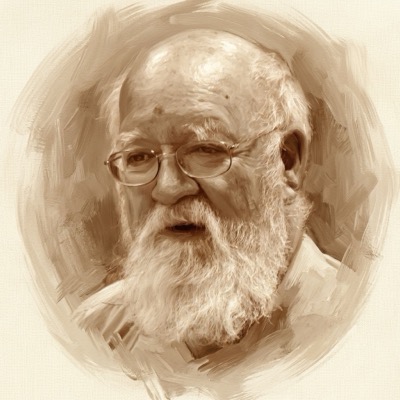
Daniel Dennett
InfluencedPhilosopher & Cognitive Scientist
Dennett's late career is one long argument that Darwin's idea is not about beetles. Darwin's Dangerous Idea (1995) reads natural selection as 'a substrate-neutral, mindless algorithm for moving through Design Space' — a universal acid that eats through every account of design reaching down from above, leaving cranes where the skyhooks were. From Bacteria to Bach and Back (2017) closes the loop this site keeps circling: competence without comprehension, sophisticated action with nobody inside who understands why it works. Written about evolution, read today it describes something else that got good at things without being told how.
en.wikipedia.org · Darwin's Dangerous Idea: Evolution and the Meanings of Life (Simon & Schuster, 1995) · en.wikipedia.org · youtube.com
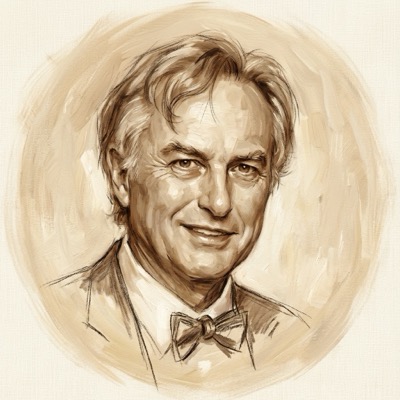
Richard Dawkins
InfluencedEvolutionary Biologist & Author
Darwin had the algorithm but not the substrate: he could not say what was inherited, and blending inheritance should have diluted every advantage away within a few generations. The Selfish Gene (1976) supplies the missing piece by moving the unit of selection down to the replicator, leaving organisms as 'survival machines' built by genes to carry them forward. The Blind Watchmaker (1986) then states Darwin's negative claim at its bluntest — a watchmaker that 'does not plan ahead, does not plan consequences, has no purpose in view,' yet whose results impress us with the illusion of design. Dawkins' sharpening is also what let the idea leave biology: once selection is about replicators rather than bodies, memes follow in the same book.
en.wikipedia.org · The Selfish Gene (Oxford University Press, 1976) · en.wikipedia.org · The Blind Watchmaker (Norton, 1986)