About
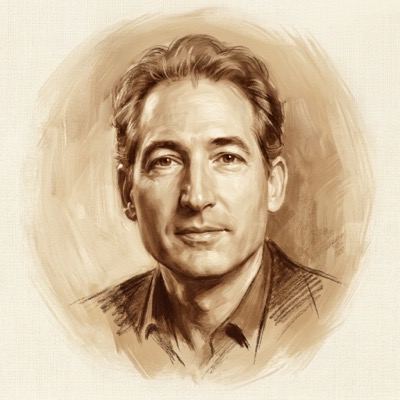
Brian Greene is an American theoretical physicist, professor of physics and mathematics at Columbia University, where he directs the Center for Theoretical Physics. His research in string theory includes the co-discovery of a class of mirror symmetry relating two different Calabi–Yau manifolds, and the description of flop and conifold transitions — changes in the topology of space itself. He wrote The Elegant Universe (1999), The Fabric of the Cosmos (2004), The Hidden Reality (2011), and Until the End of Time (2020), and hosted the NOVA miniseries adapted from the first two. In 2008 he co-founded the World Science Festival with Tracy Day, and serves as its chairman.
Key Contributions
- Co-discovered mirror symmetry, a correspondence between two distinct Calabi–Yau manifolds that became a working tool of string theory
- Described the flop and conifold transitions, showing that the topology of space can change without physics breaking down
- Wrote The Elegant Universe, a Pulitzer Prize finalist that made string theory a subject general readers could argue about
- Co-founded the World Science Festival in 2008 and chairs it, building an annual public venue where physicists, neuroscientists and philosophers share a stage
- Hosts long-form conversations on that stage — a physicist interviewing specialists in fields not his own, which is rarer than it sounds
- Has been criticised for giving string theory more public certainty than its experimental support warrants, a charge he has engaged rather than dismissed
3 conversations they hosted
Videos & Interviews
Connections
Leonard Susskind
In conversationTheoretical Physicist, Stanford
In a long World Science Festival conversation, Greene and Susskind walk from Hawking radiation through holography to the firewall paradox. Asked what string theory has actually achieved, Susskind's answer is modest and exact: not the particle spectrum, but a mathematically precise existence proof that quantum mechanics and gravity can coexist — and Greene, string theory's best-known popularizer, agrees that this alone justifies the program.
youtube.com
Marcelo Gleiser
In conversationTheoretical Physicist & Astronomer, Dartmouth College
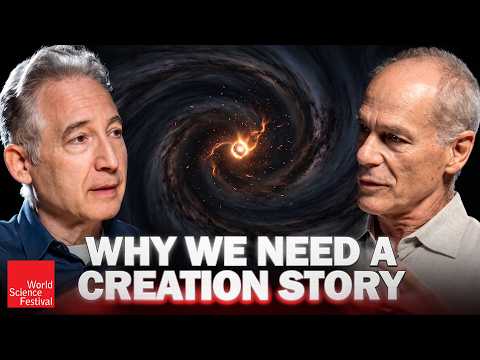
On Greene's World Science Festival stage, he and Gleiser ask whether the laws of physics are found or invented, and why we are driven to explain at all. They are two physicists who trust the method and differ on the frame around it: Greene tends to treat human meaning as something physics leaves room for, while Gleiser argues that the knower can never be subtracted from the known. The conversation is on this site.
youtube.com

